Climate Literacy
Section outline
-
Welcome to Climate Literacy! This rigorous online course is designed for communicators, educators, and community leaders who want to deepen their understanding of the science behind climate change and evidence-based, equitable solutions needed to address it. Participants will explore how climate systems function, how human actions influence climate, and how climate influences people and other parts of the Earth system. The course combines scientific readings, engaging videos, interactive simulations, systems thinking activities, and data visualizations to support a rich learning experience. While it does not focus on teaching strategies, it provides a strong scientific foundation to support confident, informed engagement with climate education materials. In addition to global climate science, the course incorporates Colorado-based resources and data to ground concepts in real-world examples; while these materials are locally focused, they serve as valuable case studies that offer insights and applications relevant to participants from any region.
Objectives and Expectations
By the end of this course, you will be able to:- Explain how Earth’s climate system functions and analyze the relationships between human systems and Earth systems.
- Interpret and apply the Climate Literacy: Essential Principles for Understanding and Addressing Climate Change (2024) to evaluate real-world climate issues and solutions
- Develop, evaluate, and justify strategies for mitigating and adapting to climate change.
As a student of this course, it is expected that you:- Commit the time required to complete all readings, assignments, and assessments.
- Complete Modules 1-9 and their associated assignments.
- Submit the final course evaluation.
Prerequisites- Experience working in education is not required but highly encouraged.
- Experience using and sharing Google Docs.
- College level reading, writing, and critical thinking skills.
Required Materials- Laptop or desktop computer with internet access.
Completing Tasks and Assignments
Throughout the course, documents will be provided in the form of Google Docs. "Make a Copy" under the File menu to edit it as your own. If necessary, you can download it as a Word document, yet this is not preferred. Assignments should be submitted as Google Docs by using the file link-sharing feature. If you have questions or would prefer another option, please contact the course moderator before submitting your first assignment.
Grading and Optional Credit- Periodic assessments throughout each module must be completed with at least 80% accuracy or a score of 2 as indicated on the scoring guide provided.
- To receive a certificate of completion, you must complete all assignments and receive the scores as indicated above. You must also participate in the online discussion.
- 1 semester hour of CSM credit can be earned from the Adams State University for an additional $55. If you are interested in earning CSM credit, you will need to complete the course with a grade of 2 or more on all assignments and pay here at any point during the course term.
Important DatesThis course runs for 8 weeks, from June 1 - July 24, 2026. This is a completely asynchronous course. You may learn at your own pace. However, we strongly recommend that you spread out your work so that you aren’t rushed at the end. To help with that, we’ve set suggested deadlines for activities throughout the course. I will also be sending regular emails reminding you to keep up the great work!
- Module 1 – Complete by June 5
- Module 2 – Complete by June 12
- Module 3 – Complete by June 19
- Module 4 – Complete by June 24
- Module 5 – Complete by June 29
- Module 6 – Complete by July 3
- Module 7 – Complete by July 10
- Module 8 – Complete by July 17
- Module 9 – Complete by July 24
Additionally, you will be required to attend at least one 1-hour online discussion with fellow eeCourse participants to share ideas, reflections on course materials, and/or final course project materials. You will receive a Doodle Poll via email to complete in order to schedule a time that works best.
Meet Your Course Moderator
You will have one moderator for this course, Sarah Johnson. The moderator is here to review your assignments, provide scores and feedback. You can reach Sarah at sarah@wildroseeducation.com. Read more about Sarah below:Hello everyone!
My name is Sarah Johnson and I am thrilled to be moderating this Climate Literacy eeCourse. I designed wrote this course for CAEE and am really looking forward to sharing it with each of you. I have been focused on climate literacy education for educators for the past 5+ years focusing on the Colorado River Basin of the West, Canada and forests, and the Arctic Ocean and sea ice.
I run a small independent education gig, Wild Rose Education where I am busy designing, teaching, and facilitating innovative environmental education learning experiences at the national and sometimes international level. I have lived in western Colorado since 2004 and currently live in Basalt, Colorado.
A couple fun facts about me: I attended the UNFCCC COP26 (UN climate meeting) in Glasgow, Scotland in 2021, every year I grow a large vegetable garden, and I play a variety of musical instruments.
I'm looking forward to getting to know a bit about each of the students in this course and participate in this learning journey together.
Cheers,
SarahGet to Know the Course
Please watch this video walk-through to learn how to navigate course modules, materials, and assignments in Moodle. Although this video uses the "Foundations of Teaching Environmental Education" eeCourse as an example, the information shared is applicable to any eeCourse.
This course was partially supported by a grant from the U.S. Environmental Protection Agency Region 8 Environmental Education Grants. It has not been formally reviewed by EPA. The views expressed in this document are solely those of the authors and do not necessarily reflect those of the Agency.
-
Description:
This module is both an introduction to this course and an introduction to climate literacy. You will draw upon your previous knowledge and begin to explore climate change concepts and the climate literacy framework.
Objectives:
After completing this module, you should be able to:- Draw a concept model of Earth’s climate system from previous knowledge.
- Describe the Climate Literacy 2024 framework and Educating for Climate Action and Justice Guidelines.
Assessment:
- Submit Module 1 Course Journal and earn a score of at least 2.
- View Scoring Guide>>
Module 1 Tasks:
-
Students mustMark as done
Before You Begin
FIRST: Access the "Climate Literacy Course Journal".You need to ‘Make a Copy’ of this Google doc file for your own use (preferred), or if necessary download it as a Microsoft Word document (not preferred).
Click on File, then click ‘Make a Copy’ or ‘Download’. You will draft and write/draw your responses to assignment questions and prompts in your own Course Journal Google doc file throughout the entire course.
Note that ONLY tasks that require a response or submission are included in the Course Journal doc; you will need to access all the course materials and instructions in the course on the Moodle Learning Management System (LMS).
At the end of each module, you will submit your Course Journal with the relevant sections completed by either sharing your own Google Doc link or uploading your complete journal as a Word file. You will continue to submit your Google Doc weblink to each of the Moodle assignments (it will be the same web link each time). Assignments will not be accepted as PDF files.
-
Students mustMark as done
Pre-Course Quiz
TASK 1: Take the Climate Science Literacy quiz. As you complete the quiz, notice what concepts are a review for you and what is new. Take note of what you would like to explore deeper for yourself as a learner.
List at least 2 specific topics you would like to know more about and why. -
Students mustMark as done
Understanding Global Change
Hand draw what you know today about how Earth’s climate system works.
TASK 2: As you watch Science of Climate Change (16:45)
- CREATE a hand drawn diagram or concept model that describes how the Earth’s climate system works. Be sure to start with the sun, a body of water, a section of land and then add many more components that address the Earth Systems including the biosphere, hydrosphere, and atmosphere (if you need support, review My NASA DATA: About Earth Systems Background Information or view pdf). Be sure to link connections, causes and effects, and the many interconnections in your diagram with symbols (e.g. arrows) and label its parts. Throughout this course you will be adding to and editing this diagram as you work through the modules.
Scan or take a photo of your diagram and insert it into your Course Journal under Module 1.
EXTENSION: Explore the BioInteractive Understanding Global Change Click and Learn tool and all the resources. -
Students mustMark as done
Explore Climate Literacy and Education Frameworks
Explore information that is deemed important for individuals and communities to know and understand about Earth’s climate, impacts of climate change, and approaches to adaptation or mitigation; and energy essential principles and foundational concepts for energy education.
TASK 3:
- READ the front matter and intro chapter (pg. I-9) to Climate Literacy Essential Principles (2024) framework
- REVIEW the Climate Literacy Essential Principle slide deck
WRITE a reflection (less than 300 words) on the content above addressing these questions:
- How would you describe climate literacy in plain language to a colleague, supervisor, neighbor, and/or friend?
- How might you see yourself using referencing, referring to and/or utilizing this framework in your professional, civic, or personal contexts?
-
Students mustMark as done
Explore Educating for Climate Action and Justice NAAEE Guidelines for Excellence
Published in 2024, these wise practices address our need to move beyond educating about climate change toward educating for climate action and justice.
TASK 4: Download the Climate and Action and Justice Guidelines pdf and specifically look at page 33 for the Guidelines Summary.
Then WRITE a reflection (no more than 300 words) addressing these questions:- Which of the Key Characteristics and/or indicator bullets jump out to you? Why?
- Scan through the Guidelines front matter (pages 1-33) and record what patterns and or trends you see throughout the Guide.
- Describe how these Guidelines and the Climate Literacy Essential Principles differ and are complementary to each other?
-
Opened: Monday, 12 August 2024, 7:11 PMStudents mustMark as done
Submit your completed Module 1 Course Journal.
- View scoring guide>>
- You may upload a Word document or submit a link to a Google Doc (preferred). If you submit a link to a Google Doc, adjust the sharing settings so that it can be viewed by anyone with the link. Click the blue Share button in the top right. A new box will open, under Get Link, select 'Anyone with the link'.
-
Description:
Explore how scientists understand the climate system through interdisciplinary observations and modeling.
Objectives:
After completing this module, you should be able to:- Describe the relationship between weather, regional climate, global climate.
- Describe how natural causes alone do not explain climate change.
- Explain climate modelling today along with the history of climate modeling.
Assessment:- Submit Module 2 Course Journal and earn a score of at least 2.
- View Scoring Guide>>
Module 2 Tasks:
-
Students mustMark as done
How We Know
Scientists understand the climate system through interdisciplinary observations and modeling.
READ the Essential Principle 1: How We Know section of the Climate Literacy Essential Principles (2024) framework (pg. 10-12)
-
Students mustMark as done
Weather vs. Climate
What is the difference between weather and climate? Climate is not the same thing as weather. Weather is the minute-by-minute condition of the atmosphere (such as temperature and precipitation) on a local scale. Climate is the long-term average weather conditions of an area. The term climate change refers to significant and persistent change in an area’s average climate conditions or their extremes.
TASK 5: READ about Weather and Climate from UCAR; then WRITE a short paragraph (less than 300 words) to describe:
- How weather and climate relate to each other.
- The types of weather that happen in your regional climate zone where you are.
- The difference between regional climate and global climate.
- How does geographic scale (neighborhood to planetary) relate to these concepts?
WATCH each of the NASA data visualizations (set slides to presentation mode and play the short video visualization on each slide) to learn more about how natural causes alone do not explain climate change.READ about the Possible Regional Tipping Points Elements from the 5th National Climate Assessment - view figure 2-15 and its caption below
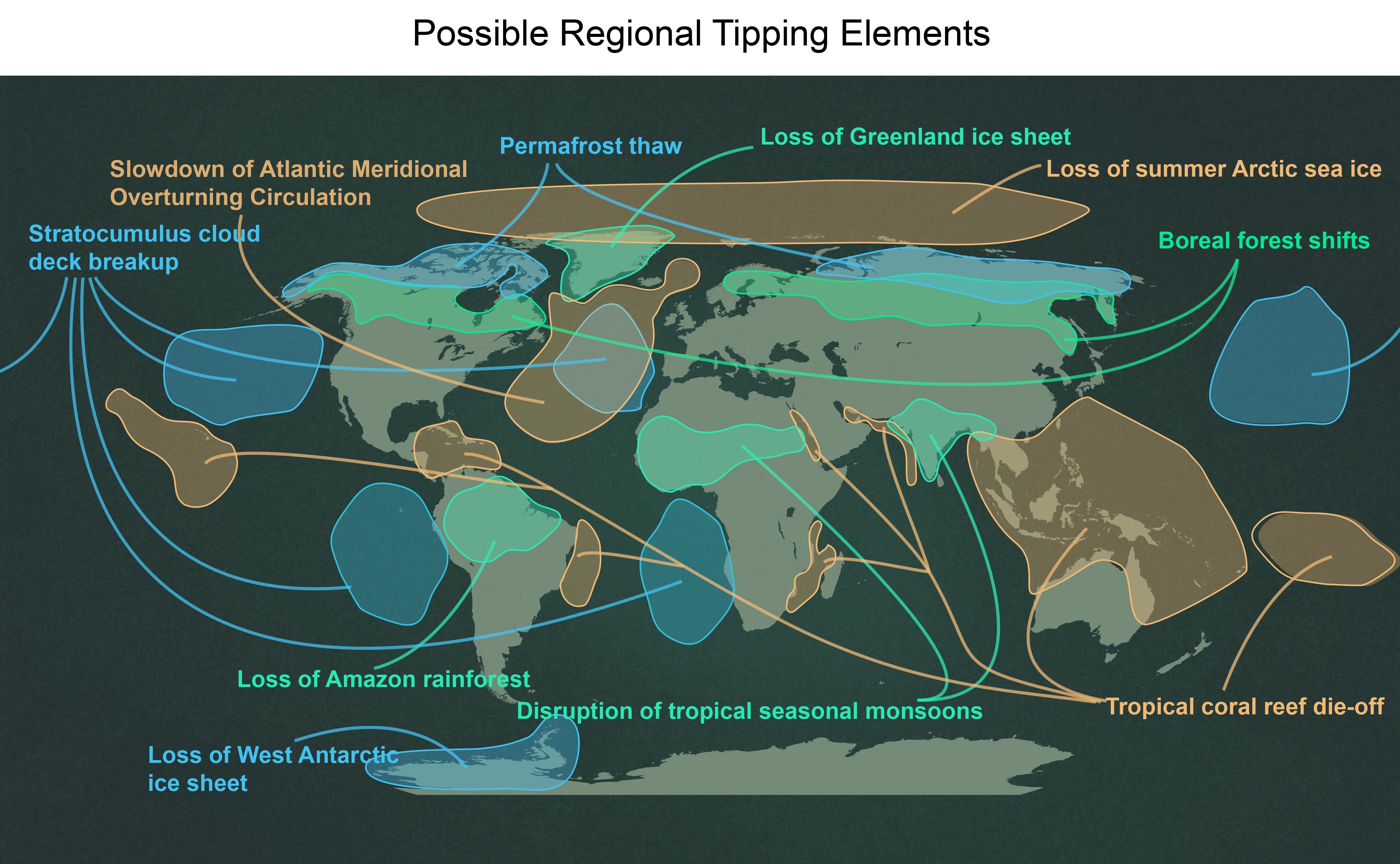
Continued warming could push some aspects of the Earth system past tipping points.
Figure 2.15. The figure shows 10 potential tipping elements in the climate system. These include changes to tropical and boreal forests and coral reefs, the loss of Greenland or West Antarctic ice sheets, and changes to the circulation of the oceans and the monsoons. The spatial area affected by each tipping element is shown; colors are used for visual clarity. Adapted with permission from Figure1 in Wang et al. 2023,240 which was adapted from McSweeney 2020. - 2023 National Climate Assessment
EXPLORE the History of Climate Science Research with either this timeline from UCAR (view as a PDF) to learn more about climate modeling history; OR this short article "The First Climate Model Turns 50, And Predicted Global Warming Almost Perfectly".
TASK 6: Considering all that you have explored and learned in this module, WRITE a response to these questions (less than 300 words):
- What concepts or topics captured your attention or struck you as powerful?
- Ideas that moved, engaged, or provoked you?
- What concepts would you like to take time to dig in and learn more about?
- How do you currently or how could you incorporate the climate literacy essential principle of “How we know” in your communications, outreach, and instruction practice?
EXTENSION: Past Climate: NOAA (or view PDF) -
Opened: Monday, 12 August 2024, 7:13 PMStudents mustMark as done
Submit your completed Module 2 Course Journal.
- View scoring guide>>
- You may upload a Word document or submit a link to a Google Doc (preferred). If you submit a link to a Google Doc, adjust the sharing settings so that it can be viewed by anyone with the link. Click the blue Share button in the top right. A new box will open, under Get Link, select 'Anyone with the link'.
-
Description:
Explore how greenhouse gases shape the Earth’s climate.
Objectives:
After completing this module, you should be able to:- Describe how Earth’s energy budget, the greenhouse effect, and the Earth system works.
- Draw a systems diagram of how Earth systems work.
Assessment:- Submit Module 3 Course Journal and earn a score of at least 2.
- View Scoring Guide >>
Module 3 Tasks:
-
Students mustMark as done
Climate Change
Greenhouse gases shape Earth’s Climate.
READ the Essential Principle 2: Climate Change section of the Climate Literacy Essential Principles (2024) framework (pg. 13-14)
TASK 7: Explore the following resources and update your climate systems diagram:- Earth’s Energy Budget: My NASA Data (or view as a PDF)
- Greenhouse Effect: UCAR (or view as a PDF)
- Sum of its Parts: Earth as a System: UCAR (or view as a PDF)
- The Climate System: UCAR (or view as a PDF)
- The Study of Earth as an Integrated System: NASA Global Climate Change Vital Signs of the Planet
- Evidence - https://science.nasa.gov/climate-change/evidence/ (or view this PDF)
- Effects - https://science.nasa.gov/climate-change/effects/ (or view this PDF)
Retrieve your Earth’s climate system diagram from Module 1 of this course. Integrate the new learning from the above resources into your diagram by hand DRAWING the parts. Feel free to add to or completely start over. Be sure to include factors that affect climate change: forcings, feedbacks, and tipping points. Be sure to include the cause-and-effect, interconnected relationships, and movement of energy using arrows, symbols, and labels.
Then, using the audio recorder on your smartphone or computer, RECORD yourself while you describe and explain your diagram in 2-5 minutes. Then insert both a photo/screenshot of your diagram and a link* for the audio file.*Pro-tip: You can share an audio file by uploading it to your personal google drive and then copy and paste the link of the google drive file into the course journal.
-
Opened: Monday, 12 August 2024, 7:14 PMStudents mustMark as done
Submit your completed Module 3 Course Journal.
- View scoring guide>>
- You may upload a Word document or submit a link to a Google Doc (preferred). If you submit a link to a Google Doc, adjust the sharing settings so that it can be viewed by anyone with the link. Click the blue Share button in the top right. A new box will open, under Get Link, select 'Anyone with the link'.
-
Description:
In this module you will explore how burning fossil fuels and other human activities are causing the planet to warm.
Objectives:
After completing this module, you should be able to:- Describe at least 3 factors that cause climate change.
- Understand that different countries around the world and various sectors contribute to climate change unequally at different scales.
Assessment:
- Submit Module 4 Course Journal and earn a score of at least 2.
- View Scoring Guide >>
Module 4 Tasks:
-
Students mustMark as done
Causes
Burning fossil fuels and other human activities are causing the planet to warm.
READ the Essential Principle 3: Causes section of the Climate Literacy Essential Principles (2024) framework (pg. 15-17)
TASK 8: Explore the following resources and respond:
- The Causes of Climate Change: NASA (or view this PDF)
- Engage with the World Emissions Clock; 1) Scroll to the ‘Compare Countries’ section and compare the major economic drivers and leaders of the world. 2) Explore the ‘Sectors Emissions’ and compare countries
WRITE a response to these questions (less than 300 words): What did you notice from the resources you explore in this module? What are you now thinking about? What does it make you wonder about? How will your understanding of causes of climate change support your communications, outreach, and instruction practice?
-
Opened: Monday, 12 August 2024, 7:15 PMStudents mustMark as done
Submit your completed Module 4 Course Journal.
- View scoring guide>>
- You may upload a Word document or submit a link to a Google Doc (preferred). If you submit a link to a Google Doc, adjust the sharing settings so that it can be viewed by anyone with the link. Click the blue Share button in the top right. A new box will open, under Get Link, select 'Anyone with the link'.
-
Description:
In this module, you will explore how rapid warming and other large-scale climate changes threaten human and ecological systems.
Objectives:
After completing this module, you should be able to:
- Describe how rapid warming and other large-scale climate changes threaten human and ecological systems.
Assessment:- Submit Module 5 Course Journal and earn a score of at least 2.
- View Scoring Guide>>
Module 5 Tasks:
-
Students mustMark as done
Impacts
Rapid warming and other large-scale climate changes threaten human and ecological systems.
READ the Essential Principle 4: Impacts section of the Climate Literacy Essential Principles (2024) framework (pg. 18-21)
TASK 9: Explore Climate Change Impacts: NOAA Education or the Water section of this PDF.Pick 1 of the impact sections you are less familiar with: Water, Food, Human Health, The Environment, or Infrastructure to dive in deeper. Explore linked webpages within the section.
WRITE a 250-300 word response about what you read and explored starting sentences with these prompts:
- What would it be like if…
- How would it be different if…
- What would/could change if…
- How would it look differently if…
- Suppose that….
-
Opened: Monday, 12 August 2024, 7:17 PMStudents mustMark as done
Submit your completed Module 5 Course Journal.
- View scoring guide>>
- You may upload a Word document or submit a link to a Google Doc (preferred). If you submit a link to a Google Doc, adjust the sharing settings so that it can be viewed by anyone with the link. Click the blue Share button in the top right. A new box will open, under Get Link, select 'Anyone with the link'.
-
Description:
Explore how climate justice is possible if climate actions are equitable.
Objectives:
After completing this module, you should be able to:- Describe climate justice using real world examples.
- Explain intersectionality and climate change.
- Describe strategies for a just transition.
Assessment:
- Submit Module 6 Course Journal and earn a score of at least 2.
- View Scoring Guide>>
Module 6 Tasks:
-
Students mustMark as done
Equity
Climate justice is possible if climate actions are equitable.
READ the Essential Principle 5: Equity section of the Climate Literacy Essential Principles (2024) framework (pg. 22-24)
TASK 10: Explore the following resources and draw a systems map:- Watch What is Climate Justice (8:09)
- Yale Experts Explain Intersectionality and Climate Change
And, choose one of the following to explore:
- Indigenous People: NCA5 Chapter Handout
- Indigenous Leadership Guides Climate Change Response: NCA5 - pages 16-22 of this pdf
- Colorado Just Transition Plan
Hand DRAW a systems map that shows the relationships, connections, and interconnections between examples of climate justice, intersectionality of identities and climate change, Indigenous leadership, and examples of real world just transition strategies. Include at least 10 nodes on your systems map along with relationship arrows and descriptors.Scan or photograph your systems map and upload/insert it into this module assignment journal space.
TASK 11: WRITE in 200 words or less how you could incorporate communicating and teaching about climate justice and equity in your communications, outreach, and instruction practice?
- Watch What is Climate Justice (8:09)
-
Opened: Monday, 12 August 2024, 7:18 PMStudents mustMark as done
Submit your completed Module 6 Course Journal.
- View scoring guide>>
- You may upload a Word document or submit a link to a Google Doc (preferred). If you submit a link to a Google Doc, adjust the sharing settings so that it can be viewed by anyone with the link. Click the blue Share button in the top right. A new box will open, under Get Link, select 'Anyone with the link'.
-
Description:
Explore how reducing emissions of greenhouse gases from human activities to net zero by 2050 can help limit global warming and climate change impacts. Use a state-of-the-art online simulation platform to suggest a strategy to collectively slow increasing global temperatures.
Objectives:
After completing this module, you should be able to:- Describe how the carbon cycle works.
- Explain what climate change is and what factors contribute to climate change on planet Earth.
- Model a scenario to mitigate climate change.
Assessment:
- Submit Module 7 Course Journal and earn a score of at least 2.
- View Scoring Guide>>
Module 7 Tasks:
-
Students mustMark as done
Mitigation
Reducing emissions of greenhouse gases from human activities to net zero by 2050 can help limit global warming and climate change impacts.
READ the Essential Principle 5: Mitigation section of the Climate Literacy Essential Principles (2024) framework (pg. 27-28)
READ about what is meant by net zero from the United Nations Net Zero Coalition
WATCH How the Paris Agreement Helps Stop Climate Change (2:50)
TASK 12: IPCC International Climate Goals and Actions by Sector - Choose at least one sectoral factsheet to download. Take note of What Can Be Done, Making it Happen, Overcoming Barriers, and Actions sections of each factsheet infographic. What feelings are you feeling as you view these infographics? Are you noticing any feelings you may not have expected? (No journal entry necessary)TASK 13: En-ROADS Simulation
- Open En-ROADS. If you are new to En-ROADS, watch the introductory video to En-ROADS and review the En-ROADS Tutorial.
- Develop a scenario. Use En-ROADS to develop your vision of limiting global warming to less than 2°C (3.6°F).
- Save your scenario link: Click on "Share Your Scenario" in the upper right-hand corner of En-ROADS, then choose "Copy Scenario Link."
- SHARE the link in the Course Journal.
After developing your preferred scenario, WRITE a concise response addressing these questions in less than 350 words:- Your Plan: What are the top 3-5 most important policies in your strategy? (For example, the most important sliders that you moved). Paste your scenario link and a screenshot of your final En-ROADS dashboard.
- Political Feasibility: To implement your proposals, what actions and priorities are needed over the next two years in businesses, civil society, government, and the public?
- Winners/ Losers: Who would be the biggest winners and losers globally in your proposed future? Create a table with two columns for winners and losers.
- Surprises: Surprises: What surprised you about the behavior of the energy and climate system as captured in En-ROADS? For example, what actions had a bigger or smaller effect than you thought?
- Hope: What trends in the world give you hope that your proposals are possible?
- Collective Impacts: What can the communities you belong to (neighborhood, town, civic groups, professional groups, etc.) do together to help create the necessary changes?
- Personal Action: What can you personally do to help create the necessary changes?
EXTENSION: UN Sectoral Solutions Interactive -
Opened: Monday, 12 August 2024, 7:18 PMStudents mustMark as done
Submit your completed Module 7 Course Journal.
- View scoring guide>>
- You may upload a Word document or submit a link to a Google Doc (preferred). If you submit a link to a Google Doc, adjust the sharing settings so that it can be viewed by anyone with the link. Click the blue Share button in the top right. A new box will open, under Get Link, select 'Anyone with the link'.
-
Description:
Explore how humans can adapt social, built, and natural environments to better withstand the impacts of climate change. Investigate available data from your local community to explore the biggest climate concerns as well as what the plans and strategies are for resilience.
Objectives:
After completing this module, you should be able to:- Use a climate data explorer platform to better understand the climate impacts and plans for resilience in unique and specific locals across the United States.
- Explain how Colorado is strategizing to address its climate resiliency priorities.
Assessment:
- Submit Module 8 Course Journal and earn a score of at least 2.
- View Scoring Guide>>
Module 8 Tasks:
-
Students mustMark as done
Adaptation
Humans can adapt social, built, and natural environments to better withstand the impacts of climate change.
READ the Essential Principle 6: Adaptation section of the Climate Literacy Essential Principles (2024) framework (pg. 25-26)
TASK 14: Use The Climate Explorer to identify what matters to your community, how climate change could affect it, and how to plan for resilience.- Type in your city, state
- Explore the data dashboard
- Click on the ‘Ready to plan for resilience?’ box. Explore the specific concerns for your area. Then explore another region of the country (perhaps a place where you have friends of family living) using the same steps above. Are there any ‘at risk neighborhoods’ identified? If so, do they correlate with other ‘at risk’ concerns in those neighborhoods?
In 200-300 words DESCRIBE what the top climate concerns are and how you and those you love and care about experience (or could experience) these concerns first hand. What actions are suggested for these people to be able to plan for resilience?
TASK 15: Learn about the Colorado Climate Resiliency Framework. Explore the six primary Resiliency Sector Frameworks. Choose one of the Resiliency Priorities that you are most connected to or concerned to dive deeper into. When reviewing the Strategies under your chosen Priority do you think it addresses the issue thoroughly enough? Is anyone left out? Are there systems not considered? What additional suggestions would you hope to see in the Strategies listed under your chosen Priority? How will your understanding of climate change adaptation support your communications, outreach, and instruction practice? (write a 250-300 word response) -
Opened: Monday, 12 August 2024, 7:18 PMStudents mustMark as done
Submit your completed Module 8 Course Journal.
- View scoring guide>>
- You may upload a Word document or submit a link to a Google Doc (preferred). If you submit a link to a Google Doc, adjust the sharing settings so that it can be viewed by anyone with the link. Click the blue Share button in the top right. A new box will open, under Get Link, select 'Anyone with the link'.
-
Description:
Explore how a livable and sustainable future for all is possible with rapid, just and transformational climate action.
Objectives:
After completing this module, you should be able to:- Describe at least 3 ways climate actions are making a real difference around the planet.
- Explain how people in your region think about climate change according to research.
- Articulate a message of hope and urgency for climate action in your interpersonal interactions.
Assessment:
- Submit Module 9 Course Journal and earn a score of at least 2.
- View Scoring Guide>>
Module 9 Tasks:
-
Students mustMark as done
Hope and Urgency
A livable and sustainable future for all is possible with rapid, just, and transformational climate action.
READ the Essential Principle 8: Hope and Urgency section of the Climate Literacy Essential Principles (2024) framework (pg. 29-30)
READ National Climate Assessment 5 Overview Section 4: Determining the Future and Section 5: A Resilient Nation
WATCH Climate Change: Why Do Social Sciences Matter? (5:21)TASK 16: Explore the Yale Climate Opinion Factsheets. Find answers to these questions by manipulating the Factsheets platform (No journal entry necessary):
- What percentage of people in your state believe that global warming is happening?
- What percentage of people in your county are worried about global warming?
- What percentage of people in your county think schools should teach about global warming? How does that compare to the state average?
- What percentage of people in your county discuss global warming at least occasionally?
- Who do people believe should do more about global warming according to this data?
TASK 17: Considering the readings, activities in this module, discuss (200-400 words) how your feelings about addressing climate change urgently has perhaps changed after reading and exploring the data. Consider how you might talk about climate change differently moving forward with your colleagues, learners, neighbors, family, and friends. How might you change your narrative a bit to incorporate messages of hope and urgency?
EXTENSION: Explore Climate Change in the American Mind
-
Students mustMark as done
Final Course Project and Reflection
TASK 18: Consider how you can apply what you have learned from this course to your communications, outreach, and/or teaching practice.DRAFT a simple outline/summary (only 1 page) of a lesson, interpretive program, communication, or any other type of outreach activity (‘the activity’) that includes a focus on climate and that you actually may use with one of your real-world audiences. Choose one topic (or more) from this course that you want to dig deeper into and center more explicitly in your activity. Demonstrate in your outline how you will integrate the climate literacy topic(s) into your activity. Be sure to call out the specific climate literacy essential principle(s) that is being integrated and centered in the activity. Name any specific resources you plan to use along with any additional people you may need to consult with to ensure the activity represents local solutions, expertise, and perspectives. Be sure to include a title, approximate amount of time needed, audience description in the outline along with the content and activities.
Draft a personal reflection on your process of learning throughout this course.TASK 19: WRITE a short reflection piece (400-600 words) that addresses the following questions:
- How did this course contribute to your understanding of climate literacy and how to address it in your personal, civic, and work environments?
- How did the flow of this course work for you to learn new information and apply it to your context?
- What are you more curious about now than you were before this course? What new questions do you have? What more do you want to explore?
-
Opened: Monday, 12 August 2024, 7:18 PMStudents mustMark as done
Submit your completed Module 9 Course Journal.
- View scoring guide>>
- You may upload a Word document or submit a link to a Google Doc (preferred). If you submit a link to a Google Doc, adjust the sharing settings so that it can be viewed by anyone with the link. Click the blue Share button in the top right. A new box will open, under Get Link, select 'Anyone with the link'.
-
-
Students mustMark as done
Discussion Group Participation
Please click the "Mark as done" button when you have participated in the online group discussion or submitted an alternate option after receiving approval from your Course Moderator.
After you have marked this task as done and all assignments have been graded, you will be able to download your completed Certificate of Completion for this course.
-
Students mustMark as done
Evaluation
Please share your experience in the course with us by completing this short evaluation! Your feedback will help us make improvements to this course for future participants.
When you are finished, click the "Mark as done" button. This task must be marked as done here in Moodle in order to receive your Certificate of Completion for this course.
-