Colorado Collective Outcomes Evaluation
Section outline
-
-
Welcome to the Collective Outcomes Evaluation eeCourse developed by CAEE and Point b(e) Strategies. This eeCourse will support you in eeProgram evaluation, from planning to communicating the results. This eeCourse is part of the Collective Outcomes Colorado Project supported by the Pisces Foundation (click here for additional information). This eeCourse will focus on supporting you in evaluating outcomes that fall under the impact areas of conservation, PreK-12 Education, Positive Youth Development, social justice, and health and wellness.
As part of the eeCourse, participants will have access to a suite of national and peer-reviewed evaluation tools measuring conservation, education, positive youth development outcomes, social justice, and health and wellness.
Objectives and ExpectationsBy the end of this course, you will be able to:
- Align your environmental education programs to Colorado’s Collective Outcomes for EE.
- Develop a theory of change and logic model for your eePrograms.
- Create an evaluation plan.
- Select and use a variety of evaluation tools.
- Effectively analyze and communicate your evaluation results.
As a participant in this course, it is expected that you:- Commit the time required to complete all readings and assignments.
- Input appropriate answers and responses in the Course Journal.
- Complete Modules 1-5 and their associated assignments, as well as submit the final course assessment. You will have 8 weeks to complete the course.
Completing Tasks and Assignments
Throughout the course, documents will be provided in the form of Google Docs. You can either download as a Word document or "Make a Copy" under the File menu to edit it was your own. Assignments can be submitted as Google Docs by using the link-sharing feature. Assignments can also be submitted by attaching Word documents. If you have questions or would prefer another option, please contact the course moderator.
Prerequisites
- Experience working in education is not required but highly encouraged.
Required Materials- You will need to provide an environmental education learning experience to evaluate.
- Collective Outcomes Toolkit
Grading- Periodic assessments throughout each module must be completed with at least 80% accuracy or a score of 2 as indicated on the scoring guide provided.
- To receive a certificate of completion, you must complete all assignments and receive the scores as indicated above.
Important Dates
This course runs for 8 weeks, from June 1 - July 24, 2026. Although you can complete the course at your own pace, below is a recommended schedule for completing each module:
- Module 1 – Complete by June 10
- Module 2 – Complete by June 22
- Module 3 – Complete by July 1
- Module 4 – Complete by July 13
- Module 5 – Complete by July 24
Additionally, you will be required to attend a 1-hour online discussion with fellow eeCourse participants to share ideas, reflections on course materials, and/or final course project materials. A Doodle Poll will be sent to all participants when the course begins to schedule a time for the Online Discussion.
Meet Your Course ModeratorYour Course Moderator is Katie Navin. Katie will be reviewing your assignments, providing scores and feedback throughout the course. Read more about Katie below!
Katie is the Executive Director at the Colorado Alliance for Environmental Education. She has been active in the field of environmental education for over 20 years. Katie has served as an educator and developed curriculum at organizations ranging from museums to residential outdoor facilities in seven different states. She joined CAEE in May of 2008 and is active in the environmental and outdoor learning community both in the state and nationally. will have one moderator for this course.
Throughout the course, you will be using the Colorado Collective Outcomes Toolkit. Meet the Toolkit Developers:
Nancy Zuercher has served as evaluator, partner and trainer for dozens of nonprofits, schools and government agencies in Colorado and across the United States. Nancy has extensive evaluation experience working with environmental organizations seeking to understand their outcomes with youth, families and educators. Nancy is excited when organizations can see and document the work they do in the community. With significant experience designing and implementing effective community engagement initiatives, Nancy brings a thoughtful and critical lens to her evaluation and community assessment work. Nancy has a master’s degree in international development from the University of Denver, with specializations in nonprofit management and statistical analysis, and a bachelor’s degree in international trade and relations from the University of Northern Colorado.
Ellie Cantor spent the past twelve years working in nonprofits focused on collaborating with communities and families to build more equitable educational outcomes for youth. Prior to embarking on consulting for nonprofits, she worked for Girls Who Code as their Regional Partnership Coordinator for Colorado where she expanded access to coding curricula by 290% across the State. She previously spent seven years working with D.C. Public Schools on family engagement and promoting authentic community - school partnerships through her leadership roles at Communities In Schools and Turning the Page. Ellie graduated with a Master’s in Education Policy and Leadership Studies from the University of Washington’s College of Education and a Bachelor’s in English and French Literature from the University of Virginia. Ellie lives in Denver, Colorado with her husband and their two-year-old son who keeps them busy and entertained by his exploration of the world.
The first two years of the Colorado Collective Outcomes Project was spearheaded by CAEE and Blue Lotus Evaluation and Consulting. It would not have been possible without the contributions of:
Corrie Colvin Williams, PhD is at her core, a geographer. It's how she fell in love with this whole human-nature connection thing in the first place; a serendipitous find as an undergraduate pre-med transfer. Corrie is now a qualitative researcher by training and came to be so through great collaborations and mentoring, primarily during her tenure as a graduate research assistant in the Children, Youth & Environments Center at CU Boulder. Prior to that, she plunked around as an environmental scientist in the Texas hill country.
Kelly Keena, PhD currently serves as the Director of Education and Outreach for Underwriters Laboratories where she works on educational strategies and interventions including the creation of high-quality resources for educators based on the science and engineering at UL. Prior to joining the UL team, Kelly was co-founder and Principal Consultant for Blue Lotus Consulting & Evaluation. In addition to more than ten years as a non-formal educator and ten years of classroom work as a science teacher and instructional coach, she served as the Chair of the National Environmental Education Advisory Council for the Environmental Protection Agency where she worked on national environmental education priorities and partnerships, including evaluation, for six years. She has a BA in International Environmental Geography, an MA in Curriculum & Instruction, and a PhD in Educational Leadership and Innovation. Kelly was recently honored with a lifetime achievement award from the Colorado Alliance for Environmental Education.
The toolkit also benefited from the expertise and feedback from an Advisory Council of funders, eePractitioners, and evaluators.
Get to Know the CoursePlease watch this video walk-through to learn how to navigate course modules, materials, and assignments in Moodle. Although this video uses the "Foundations of Teaching Environmental Education" eeCourse as an example, the information shared is applicable to any eeCourse.
-
DESCRIPTION: This module introduces evaluation in environmental education and the core values we should consider as we undertake our own evaluations.
OBJECTIVES:
After completing this module, you should be able to:
- Identify your reasons for engaging in evaluation.
- Define program evaluation.
- Identify the core values for environmental education evaluation.
- Evaluate strengths and weaknesses in application of the core values in EE evaluation.
BENCHMARK ASSESSMENT:- Completion of Module 1 Course Journal entries
- View Scoring Guide>>
ESTIMATED MODULE LENGTH: 1 hour
Module 1 Tasks
-
Students mustMark as done
Review Current Evaluation Practices
We regularly engage in evaluation, both formally and informally. In the following tasks, you will think about the ways in which you currently engage in evaluation.
TASK 1: Access the Collective Outcomes evaluation Course Journal.
You will need to either Make a Copy of this file and edit it as your own Google Doc or download it as a Microsoft Word document. Click File, Make a Copy or Download. You will record responses to prompts and complete tasks in your own version of the Course Journal throughout this course. At the end of each module, you will submit your Course Journal with the relevant sections completed.
TASK 2: Watch the following video of evaluator Kathayoon Khalil discussing the skills you need to be a great evaluator.
Record your responses to the following questions in your course journal:- How would you define the term evaluation?
- Why are you interested in evaluation at this time?
- What are you hoping to learn about eeEvaluation in this course? Record 3-7 questions that you have.
- How are you currently engaged in evaluation?
- Describe your strengths and what you would like to improve in your evaluation practice in 1-2 paragraphs.
TASK 3: Read page 2 of the Collective Outcomes Module 1 Toolkit. Answer the following questions in your Course Journal:- Compare the definition of evaluation in the toolkit to the definition you recorded in Task 2. Record any similarities or differences.
- Which of the reasons for evaluation listed on page 2 of the toolkit resonate with you and the needs of your organization and why?
-
Students mustMark as done
Core Values of eeEvaluation
NAAEE developed a set of core values to guide evaluation in environmental education based on the collective wisdom of EE researchers, practitioners, policymakers, funders and evaluators. These core values help define the relationship between effective program evaluation and environmental education, in order to conduct high-quality program evaluation that contributes to healthier communities and equitable outcomes. We will be coming back to these core values throughout the course.
TASK 4: Watch the following video describing the core values of eeEvaluation and then read the descriptions of each of the values on page 3 of toolkit.In your course journal, describe how you currently practice each value. Include your strengths as well as areas for improvement.Collective Evaluation:
Equity in Motion:
Authentic Engagement:
Deep Curiosity:
Lifelong Learning and Critical Reflection:
High-Quality Evaluation:
-
Opened: Tuesday, 3 January 2023, 2:00 AMStudents mustMark as done
Submit your completed Module 1 Course Journal.
- View scoring guide>>
- You may upload a Word document or submit a link to a Google Doc. If you submit a link to a Google Doc, adjust the sharing settings so that it can be viewed by anyone with the link. Click the blue Share button in the top right. A new box will open, under Get Link, select 'Anyone with the link'.
-
DESCRIPTION: This module introduces the Colorado Collective Outcomes and supports organizations in aligning their work to the applicable collective outcomes. This module also provides tools and direction in developing and/or refining a logic model and theory of change.
OBJECTIVES:
After completing this module, you should be able to:
- Identify Colorado Collective Outcomes that you would like to measure and outcomes that you already measure.
- Create a theory of change for your eeProgram.
- Use the collective outcomes to build or update a logic model for your eeProgram.
BENCHMARK ASSESSMENT:
- Completion of Module 2 Course Journal entries
- Completion of Logic Model
- View Scoring Guide>>
Module 2 Tasks:
-
Students mustMark as done
Getting Started
TASK 1: You may offer a number of programs at your organization. For the purposes of this course and the remaining assignments, you will want to select one program to focus on. In your Course Journal, briefly describe (5-7 sentences) the program you selected.
-
Students mustMark as done
Using Colorado Collective Outcomes to Help Identify Outcomes
Understanding what we want to achieve can help us collect the most relevant data in an evaluation. CAEE has been engaged in a multi-year effort to bring together EE practitioners, evaluators, and funders to discover the common and shared outcomes that EE programs and learning experiences are trying to achieve. CAEE initiated a robust process of gathering community feedback to start establishing collective outcomes in Colorado. By developing a shared language and common understanding of intended outcomes, we can create tools, resources, and learning that can be shared across organizations.
TASK 2: Read pages 3-8 in the Collective Outcomes Toolkit. Review the Collective Outcomes found on page 7-8 of the toolkit. What impact areas do you think your selected program align best with?
TASK 3: Who are the primary stakeholders and audiences for your program evaluation? List 5-10 potential stakeholders (i.e. board, organizational team, teachers, funders, participants, etc.) who might be interested in the evaluation and its results in your course journal. Identify the impact area from the collective outcomes (i.e. conservation, K-12 education, positive youth development, social justice and health and wellness) that you think is most important to each stakeholder and why.
TASK 4: Next, you need to determine what outcomes you want to measure in your evaluation. You can use the collective outcomes on page 7-8 of the toolkit to get started. Which outcomes are you already measuring? Which would you like to measure? Which outcomes are your learners and other stakeholders most interested in? In your Course Journal complete the Alignment Worksheet to help you identify aligned outcomes.
TASK 5: How might utilizing the Colorado Collective Outcomes Project support your organization and your work? What challenges do you see in utilizing shared outcomes? Are there other outcomes you would like to measure? Record your answers in your Course Journal.
TASK 6: Environmental education learning experiences can impact learners in a variety of ways. Our programs often support more outcomes than we have the time and/or resources to collect data on. In your course journal, record answers to the following questions:
Using the table from Task 6- identify 3-5 that are the most important to you? Why?
What other stakeholders for your EE learning experience might have feedback in selecting which program outcomes are most important?
How might you engage your program or learning experience participants and stakeholders in this process?
OPTIONAL: Share the attached worksheet with your coworkers/team and other stakeholders to help you identify aligned outcomes. Download a version in Word.
-
Students mustMark as done
Creating a Theory of Change
Articulating a deep understanding of your program can support you in creating a strong evaluation. When beginning to map out your evaluation, it is helpful to start by articulating a Theory of Change for your programs. A Theory of Change statement describes the overall goals of the program and how the program will reach them. A comprehensive theory of change takes into consideration the following:
- Needs of the community and/or the problem the program plans to address
- The target population the program serves
- Key program elements
- Intended goals and outcomes
TASK 7: Create your theory of change using the formula, "By providing X to Y, Z will occur." See page 9 of the toolkit for more information on creating a theory of change. Record your theory of change in your course journal. Examples include:
- By providing a weeklong experiential outdoor education program to sixth-grade students at Outdoor Education Center, students will increase their knowledge and awareness of environmental stewardship.
- By providing outdoor behavioral healthcare programming to youth, youth will reduce behavioral problems, develop social skills, and overcome mental health challenges.
-
Students mustMark as done
Building a Logic Model
In order to evaluate your programs accurately and efficiently, you must first have a clear understanding of what your programs are trying to accomplish and how they intend to do it. One way to do this is by developing a programmatic logic model. A logic model is a high-level visual representation of a program that links program activities to intended outcomes.
TASK 8: Read pages 10-12 of the Colorado Collective Outcomes Toolkit. Using the chart in your course journal build a logic model for your program. Refer to the Collective Outcomes on pages 7-8 of the Toolkit, as you fill it out. What program level outcomes can be used as short and medium-term outcomes for your program? What population level outcomes can be used as long-term outcomes for your program?
-
Opened: Wednesday, 4 January 2023, 2:00 AMStudents mustMark as done
Submit your completed Module 2 Course Journal.
- View scoring guide>>
- You may upload a Word document or submit a link to a Google Doc. If you submit a link to a Google Doc, adjust the sharing settings so that it can be viewed by anyone with the link. Click the blue Share button in the top right. A new box will open, under Get Link, select 'Anyone with the link'.
-
DESCRIPTION: In Module 1 you learned how to articulate a Theory of Change for your programs and the importance of creating a Logic Model. Additionally, you looked at the Colorado Collective Outcomes Project and how to identify collective outcomes that are aligned with your specific programs. The next step is to define evaluation questions and develop an evaluation plan. Through the evaluation planning process, you will learn how to select the appropriate evaluation tools to help you better understand whether a program is achieving its outcomes.
OBJECTIVES:
After completing this module, you should be able to:
- Create an evaluation plan for your program.
- Identify tools for engaging in evaluation.
- Evaluate ways to navigate evaluation challenges.
BENCHMARK ASSESSMENT:
- Completion of Module 3 Course Journal entries
- Completion of Evaluation Plan
- View Scoring Guide>>
ESTIMATED MODULE LENGTH: 3 hoursModule 3 Tasks:
-
Students mustMark as done
Crafting Evaluation Questions
Evaluation questions guide the evaluation. It is often unrealistic to evaluate everything you want to explore about the program. Prioritizing evaluation questions will help focus your time and resources. Note: Evaluation questions refer to big, broad questions that define what you want to learn from your evaluation. These are not necessarily the questions that you will include in your survey or evaluation tool.
TASK 1: Review page 3 of Module 2 in the Collective Outcomes Toolkit. Refer to the list of program stakeholders you identified in Module 2: Task 4. Select 5 of the stakeholders and identify at least one question the stakeholder might have for the evaluation in your course journal (Include program participants as at least one of your stakeholders.)
TASK 2: Select at least 1 of the stakeholders you listed above and interview them to learn more about what they would be interested in learning from the program evaluation. Identify ways you might be able to engage other stakeholders listed above in identifying evaluation questions. Record your reflections (~1 paragraph) in your course journal.
TASK 3: Based on your conversation and the information that will support you in improving your program, list 3-5 evaluation questions you will be focusing on in your course journal.
-
Students mustMark as done
Evaluation Plan
The final step in developing your evaluation is thinking through each element of the evaluation plan. Like the logic model, an evaluation plan helps provide a concise picture of your evaluation.
TASK 4: Start working on your evaluation plan. Read pages 4-7 of the Collective Outcomes Module 2 Toolkit. Using your evaluation questions, fill in the outcomes (select outcomes from your logic model and the Colorado Collective Outcomes), indicators, and objectives you would like to measure in your evaluation in the table in your course journal.TASK 5: Do you have any data that can be re-purposed to answer your evaluation questions? (e.g., registrations, applications, attendance records, participant projects and using embedded assessments or assessments that are directly built into your programming). Don’t forget the easy data! As a part of your evaluation work plan, remember some of the "simple" indicators such as counting the participants at events or the number of bags of litter collected on river clean-up day. It can be easy to forget to collect this information when you focus on the more intensive tasks of developing and administering evaluation instruments. What existing data might you be able to use? Record possible existing data sources in your course journal.
TASK 6: What additional data will you need? Read pages 8-12 in the Collective Outcomes Module 2 Toolkit. What kind of data (qualitative or quantitative) will best answer your evaluation questions? Which type of tools (surveys, interviews, etc.) might be the most useful for your program? Record your reflections in your course journal.
TASK 7: Time is one of the biggest barriers in collecting data. Evaluations tend to be most successful when they are built into the program structure. Review the Program Learning Cycle Developed by the BEETLES Project. Are there opportunities to build evaluation into the program or learning experience reflection? How could the evaluation process support participant learning AND provide meaningful data? Record your thoughts and ideas in your course journal.
TASK 8: Review the variety of sample evaluation tools available on pages 14-18 of the Collective Outcomes Module 2 Toolkit. You can access the full tools using EITHER the database or folders included below (both contain the same information). Select at least one of the tools and modify it for your program. You may want to combine questions from several different tools or modify an existing tool that your organization uses to better reflect the Colorado Collective Outcomes. Copy the tool and your modifications into your course journal.
-
Students mustMark as done
When creating your evaluation plan and selecting your data collections tool and methods, you can use (in whole or in part) tools aligned with the Colorado Collective Outcomes Project. Search for tools by outcome area.
-
You can find sample evaluation tools in each impact area folder.
-
Students mustMark as done
TASK 9: Look back to the outcomes, indicators, and objectives you drafted in Task 4. Make any changes based on your reflections and complete the Data Collection Tools and Methods Column.
TASK 10: Who and when will you administer your evaluation? Be thoughtful about who collects the data. For example, in a youth program, does it make sense for youth to help collect the data? If you’re conducting a focus group, does it make sense for a BIPOC person to lead that focus group? Does it make sense to have an environmental educator other than the one who taught the session collect feedback on the educational experience? It matters who does the asking. How often will you collect data? Be sure to design your evaluation so that it is feasible to implement. Complete the final column, “Staff and Timing” in your evaluation plan, in your course journal.
TASK 11: Identify your next steps. Do you need to modify any additional tools? What actions do you need to take to put your evaluation plan into action? Record your reflections in your course journal.
-
Opened: Thursday, 5 January 2023, 2:00 AMStudents mustMark as done
Submit your completed Module 3 Course Journal.
-
DESCRIPTION:
Throughout this training series, you’ve taken time to authentically engage with your participants; understand your program and map it out using a logic model; develop an evaluation plan that defines your outcomes and objectives; and identify tools and data collection methods to gather data from your participants. Hopefully, you have had the opportunity to administer surveys and use the data collection methods with your participants. The final step in the evaluation process is analyzing the data and reporting results. While data analysis can feel intimidating, it is actually one of the most exciting phases of the evaluation process. This is when you learn what is working and where there are opportunities for improvement.
OBJECTIVES:
After completing this module, you should be able to:
- Describe the process for analyzing quantitative data.
- Describe the process for analyzing qualitative data. Identify opportunities to navigate the challenges of data analysis.
BENCHMARK ASSESSMENT:
- Completion of Module 4 Course Journal entries
- Completion of Evaluation Plan
- View Scoring Guide>>
ESTIMATED MODULE LENGTH: 2 hours
Module 4 Tasks:
-
Students mustMark as done
Analyzing Quantitative Data
Quantitative data refers to numerical data, data that can be defined by categories, or data that can be placed on a scale. Quantitative data can be converted (or coded) into numerical data for analysis.
TASK 1: Read pages 3-8 in the Collective Outcomes Module 3 Toolkit. If you have quantitative data that you have collected, please select 10 surveys that you have collected to complete the following activity. If you don’t have any quantitative data, you can download the 10 sample surveys to complete the activity. Download the Analyzing Quantitative Data spreadsheet and fill in the data using your own or sample surveys. Review the instructions on the first worksheet and then complete the Survey code worksheet and the data collection and calculation worksheet. There are also several samples included for your reference.
TASK 2: In your Course Journal record at least 5 findings from your quantitative data analysis. What conclusions might you draw from this data?
TASK 3: Using your evaluation plan, describe how you will analyze any quantitative data that you collect? What types of calculations and information will be most helpful to you?
TASK 4: What challenges do you think you will encounter in analyzing quantitative data? How can you navigate those challenges? Record your reflections in your Course Journal. -
Students mustMark as done
Analyzing Qualitative Data
Unlike quantitative data, qualitative data is not inherently numerical as it includes descriptive and narrative data. It is important to note, however, that you can still analyze qualitative data. Through qualitative data analysis, you can identify themes or trends and determine findings about those involved in the evaluation.
TASK 5: Read pages 9-10 in the Collective Outcomes Module 3 Toolkit. Download a copy of the Analyzing Qualitative Data Spreadsheet. Review the instructions on the first worksheet. Review the sample data and codings. Notice the themes identified by the evaluator. Next, complete the Qualitative Data Analysis Worksheet in the spreadsheet. Using the open-ended responses provided identify common themes and calculate how often respondents mentioned a theme. (If you have your own qualitative data you would like to analyze, you can use your own data.)
TASK 6: In your Course Journal record at least 5 findings from the data that you might share with program stakeholders. What conclusions can you draw from the data? In addition to reporting on the overall trends and themes in the data, how might you use qualitative data to help illustrate your findings?
TASK 7: Using your evaluation plan, describe how you will analyze any qualitative data that you collect? What themes (based on your outcomes) will you be looking for in your qualitative data?
TASK 8: What challenges do you think you will encounter in analyzing qualitative data? How can you navigate those challenges? Record your reflections in your course journal.
TASK 9: Describe 3-5 learnings about analyzing data. -
Opened: Thursday, 12 January 2023, 2:00 AMStudents mustMark as done
Submit your completed Module 4 Course Journal.
-
DESCRIPTION:
Now that you have analyzed the data, it is time to report it to your stakeholder groups. Before reporting and presenting your results, we will refer to our initial evaluation questions. What do you want to learn from the evaluation and who is the intended audience? In this module, we will explore a variety of communication tools for communicating our results.
OBJECTIVES:
After completing this module, you should be able to:
- Describe 5 recommendations for telling a more effective story about environmental education.
- Identify at least one metaphor that will help you explain your results.
- Draft boiler plate that language that can be used in funding or program proposals and/or evaluation reports.
BENCHMARK ASSESSMENT:
- Completion of Module 5 Course Journal entries
- Completion of Evaluation Plan
- View Scoring Guide>>
ESTIMATED MODULE LENGTH: 2 hours 30 minutes
Module 5 Tasks:
-
Students mustMark as done
Identify your Audience
An important part of the process is sharing your story. What worked for your organization? What did you learn? Who can benefit or learn from your evaluation? How might you share your story with participants, staff, funders, other organizations, and the environmental education community?
TASK 1: How will you tell your evaluation story? There are many ways to share your findings, such as through events or written reports. Refer to the audiences you identified in Module 3: TASK 1. Select at least one of the audiences for your evaluation and describe how you might share the data and results with them (i.e. grant report, presentation, one-on-one or community meeting, etc.). Next describe how you will share results with the participants and/or community for your program. (i.e If you program is designed for 1st graders, how will you share the results with parents or participating teachers?) Record your reflections in your course journal.
TASK 2: Using your evaluation plan and reflections from Module 4 “Analyzing Data”, which quantitative and/or qualitative data will your audience be most interested in? Select 3-5 data points that you would like to share with stakeholders and record in your course journal.
TASK 3: For each of the 3-5 data points listed above, think of a brief anecdotal story or experience with a learner that might illustrate the data point. Briefly describe those stories in 1-3 sentences in your course journal. -
Students mustMark as done
Telling a More Effective Story about Environmental Education
CAEE partnered with the FrameWorks Institute and Environmental Education New Mexico in 2020 to develop a framing strategy for advocates, educators, practitioners and program leaders to tell a more effective story about environmental education. By utilizing a shared framing strategy, we can avoid common pitfalls and provide a clear vision for strengthening environmental education and expanding access to opportunities for everyone. -
Students mustMark as doneTASK 4: Watch the "How to Tell a More Effective Story about Environmental Education Webinar" through minute 34:51.
TASK 5: Read the following statement and how it was reframed using a clear description of environmental education.
Before: To develop an environmentally literate population that is able to solve the environmental and social challenges we will face this century, environmental education must be part of our nation’s K–12 curriculum.
Reframed with a clear description of what environmental education is: To cultivate an engaged citizenry that is able to solve the environmental and social challenges of this century, we must integrate field trips, hands-on science lessons, and other outdoor activities into our nation’s K–12 curriculum.
Start with why. Using the above statement as an example, craft a sentence that provides a clear description of your program and why it’s important without using the words environmental education.
TASK 6: Why does everyone deserve to experience your program? Connect to your audience’s values. Review pages 8-9 of the “How to tell a More Effective Story about Environmental Education” Framing Guide. Read the following example of re-framing using the value of future preparation.
Before Framing: Everyone deserves the opportunity to have meaningful outdoor experiences, because when people connect with nature, we all benefit.
Reframed with the value of future preparation: Meaningful outdoor experiences bring us together to learn about our world, including how to best care for and sustain it for future generations.
Using the above reframed statement as an example, craft a sentence that describes why your program is important to all of us using one of the following values recommended by the Frameworks Institute: Future Preparation, Human Potential or Protection. Think about the values of your audiences when crafting your sentence.
TASK 7: Explain key processes and relationships about your program. Explaining complex processes to funders and stakeholders can be difficult, and often takes time. One tool that can help is to provide an analogy between a new or abstract concept, and a comparable but more familiar and concrete one. Select one of the metaphors on page 14 of the Module 3 Collective Outcomes Toolkit that resonates to help explain your program. Craft a sentence about your program utilizing one of the metaphors. You can read more about these metaphors on pages 10-12 of the “How to Tell a More Effective Story about Environmental Education” framing guide.
TASK 8: “An appeal to Inclusive Opportunity can facilitate more productive public thinking about the essential supports we all depend on to thrive. FrameWorks developed this tool for advocates of family, school, and community engagement. Here’s the concept to be conveyed: Opportunity is more than a vaguely inspirational notion—it’s a set of practical measures and material conditions that are required to fulfill universal needs. These measures are already in place for some communities, but where they’re lacking or missing altogether, we have more work to do. Using the tool “Inclusive Opportunity” helps communicators avoid activating the default public assumption that some groups are “needier” than others, and instead call attention to the ways that our social policies and institutions can be restructured to better serve us all.” - “How to Tell a More Effective Story about Environmental Education” Page 13
For example:
Before text: Educators have called environmental education an “equalizer” for kids who are struggling, as well as for those excelling or those with special needs. In fact, many educators find that the kids who are hardest to reach become enthusiastic and absorbed in the learning process.
Reframed with Inclusive Opportunity: Kids thrive when they’re encouraged to experience a range of educational settings and allowed to discover how they learn best. Environmental education provides essential opportunities for all kids, whether their best learning happens inside the classroom or outside.
Craft a sentence about your program that demonstrates how all participants would benefit from programs like yours.
TASK 9: Provide your evaluation audience with concrete solutions that we can implement together. Review recommendation #5 on pages 15-16 of the “How to tell a more Effective Story about Environmental Education Toolkit”. Craft a sentence about your program that offers a concrete solution that your audience can be an active participant in. -
Students mustMark as done
Telling Your Story
When you share your story with your evaluation stakeholders follow the three-step process depicted in the graphic below. Start with why your program is important, explain how your program is making an impact on the issues your stakeholders find important, and finally offer a solution that they can be or continue to be a part of.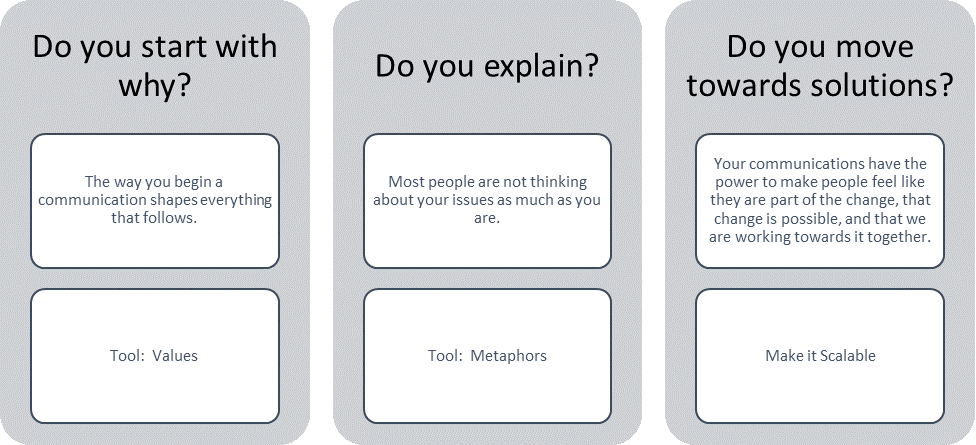
TASK 10: Using what you have learned throughout this module, complete one of the following for the audience you identified at the beginning of the module:
TASK 11: Reflect on how the voice of your community can be represented in your communication with key stakeholders. Are you including all voices? Are you aware of how power or bias might be present in reporting? Record your reflections in your course journal.Option 1: Write 1-2 paragraphs to tell your evaluation story including at least one quantitative and/or qualitative data point from your analyzed data and one anecdotal story that might illustrate your data.
Option 2: Create 3-7 slides to tell your evaluation story including at least one quantitative and/or qualitative data point from your analyzed data and one anecdotal story that might illustrate your data. If you don’t have analyzed data at this point in your process, you can use fictionalized data.
TASK 12: Part of creating culturally responsive evaluation includes engaging program participants and stakeholders in learning and decision making based on evaluation data. How might you include participants and key stakeholders in making future changes to the program? How might you tell your story to key stakeholders and partners differently to engage your program participants? Record your reflections in your course journal. -
Students mustMark as done
Pulling it All Together
TASK 13: Review the things you were hoping to learn about eeEvaluation in your course journal at the beginning of course. What have you accomplished? What do you still have questions about? Record your reflections in your course journal.
Task 14: How have your strengths and what you would like to improve in your evaluation practice changed since the beginning of the course?
Task 15: It may be helpful to think about one or two things you might tweak or change in your evaluation practice and slowly build over time. How will you continue to build and grow your evaluation practice? Record at least two action steps in your course journal. -
Opened: Tuesday, 17 January 2023, 2:00 AMStudents mustMark as doneSubmit your completed Module 5 Course Journal.
-
Opened: Tuesday, 17 January 2023, 2:00 AMStudents mustMark as done
Your final assignment for this course is to submit a Course Evaluation.
After completing the evaluation and checking the completion box, you will be able to download/print a certificate of completion for your records. The certificate will not appear until all activities and assignments are marked complete and have a passing grade.
-
-
Students mustMark as done
Discussion Group Participation
Please click the "Mark as done" button when you have participated in the online group discussion or submitted an alternate option after receiving approval from your Course Moderator.
After you have marked this task as done and all assignments have been graded, you will be able to download your completed Certificate of Completion for this course.
-
Students mustMark as done
Evaluation
Please share your experience in the course with us by completing this short evaluation! Your feedback will help us make improvements to this course for future participants.
When you are finished, click the "Mark as done" button. This task must be marked as done here in Moodle in order to receive your Certificate of Completion for this course.
-