Module 5: Telling your Evaluation Story and Communicating Results
Section outline
-
DESCRIPTION:
Now that you have analyzed the data, it is time to report it to your stakeholder groups. Before reporting and presenting your results, we will refer to our initial evaluation questions. What do you want to learn from the evaluation and who is the intended audience? In this module, we will explore a variety of communication tools for communicating our results.
OBJECTIVES:
After completing this module, you should be able to:
- Describe 5 recommendations for telling a more effective story about environmental education.
- Identify at least one metaphor that will help you explain your results.
- Draft boiler plate that language that can be used in funding or program proposals and/or evaluation reports.
BENCHMARK ASSESSMENT:
- Completion of Module 5 Course Journal entries
- Completion of Evaluation Plan
- View Scoring Guide>>
ESTIMATED MODULE LENGTH: 2 hours 30 minutes
Module 5 Tasks:
-
Students mustMark as done
Identify your Audience
An important part of the process is sharing your story. What worked for your organization? What did you learn? Who can benefit or learn from your evaluation? How might you share your story with participants, staff, funders, other organizations, and the environmental education community?
TASK 1: How will you tell your evaluation story? There are many ways to share your findings, such as through events or written reports. Refer to the audiences you identified in Module 3: TASK 1. Select at least one of the audiences for your evaluation and describe how you might share the data and results with them (i.e. grant report, presentation, one-on-one or community meeting, etc.). Next describe how you will share results with the participants and/or community for your program. (i.e If you program is designed for 1st graders, how will you share the results with parents or participating teachers?) Record your reflections in your course journal.
TASK 2: Using your evaluation plan and reflections from Module 4 “Analyzing Data”, which quantitative and/or qualitative data will your audience be most interested in? Select 3-5 data points that you would like to share with stakeholders and record in your course journal.
TASK 3: For each of the 3-5 data points listed above, think of a brief anecdotal story or experience with a learner that might illustrate the data point. Briefly describe those stories in 1-3 sentences in your course journal. -
Students mustMark as done
Telling a More Effective Story about Environmental Education
CAEE partnered with the FrameWorks Institute and Environmental Education New Mexico in 2020 to develop a framing strategy for advocates, educators, practitioners and program leaders to tell a more effective story about environmental education. By utilizing a shared framing strategy, we can avoid common pitfalls and provide a clear vision for strengthening environmental education and expanding access to opportunities for everyone. -
Students mustMark as doneTASK 4: Watch the "How to Tell a More Effective Story about Environmental Education Webinar" through minute 34:51.
TASK 5: Read the following statement and how it was reframed using a clear description of environmental education.
Before: To develop an environmentally literate population that is able to solve the environmental and social challenges we will face this century, environmental education must be part of our nation’s K–12 curriculum.
Reframed with a clear description of what environmental education is: To cultivate an engaged citizenry that is able to solve the environmental and social challenges of this century, we must integrate field trips, hands-on science lessons, and other outdoor activities into our nation’s K–12 curriculum.
Start with why. Using the above statement as an example, craft a sentence that provides a clear description of your program and why it’s important without using the words environmental education.
TASK 6: Why does everyone deserve to experience your program? Connect to your audience’s values. Review pages 8-9 of the “How to tell a More Effective Story about Environmental Education” Framing Guide. Read the following example of re-framing using the value of future preparation.
Before Framing: Everyone deserves the opportunity to have meaningful outdoor experiences, because when people connect with nature, we all benefit.
Reframed with the value of future preparation: Meaningful outdoor experiences bring us together to learn about our world, including how to best care for and sustain it for future generations.
Using the above reframed statement as an example, craft a sentence that describes why your program is important to all of us using one of the following values recommended by the Frameworks Institute: Future Preparation, Human Potential or Protection. Think about the values of your audiences when crafting your sentence.
TASK 7: Explain key processes and relationships about your program. Explaining complex processes to funders and stakeholders can be difficult, and often takes time. One tool that can help is to provide an analogy between a new or abstract concept, and a comparable but more familiar and concrete one. Select one of the metaphors on page 14 of the Module 3 Collective Outcomes Toolkit that resonates to help explain your program. Craft a sentence about your program utilizing one of the metaphors. You can read more about these metaphors on pages 10-12 of the “How to Tell a More Effective Story about Environmental Education” framing guide.
TASK 8: “An appeal to Inclusive Opportunity can facilitate more productive public thinking about the essential supports we all depend on to thrive. FrameWorks developed this tool for advocates of family, school, and community engagement. Here’s the concept to be conveyed: Opportunity is more than a vaguely inspirational notion—it’s a set of practical measures and material conditions that are required to fulfill universal needs. These measures are already in place for some communities, but where they’re lacking or missing altogether, we have more work to do. Using the tool “Inclusive Opportunity” helps communicators avoid activating the default public assumption that some groups are “needier” than others, and instead call attention to the ways that our social policies and institutions can be restructured to better serve us all.” - “How to Tell a More Effective Story about Environmental Education” Page 13
For example:
Before text: Educators have called environmental education an “equalizer” for kids who are struggling, as well as for those excelling or those with special needs. In fact, many educators find that the kids who are hardest to reach become enthusiastic and absorbed in the learning process.
Reframed with Inclusive Opportunity: Kids thrive when they’re encouraged to experience a range of educational settings and allowed to discover how they learn best. Environmental education provides essential opportunities for all kids, whether their best learning happens inside the classroom or outside.
Craft a sentence about your program that demonstrates how all participants would benefit from programs like yours.
TASK 9: Provide your evaluation audience with concrete solutions that we can implement together. Review recommendation #5 on pages 15-16 of the “How to tell a more Effective Story about Environmental Education Toolkit”. Craft a sentence about your program that offers a concrete solution that your audience can be an active participant in. -
Students mustMark as done
Telling Your Story
When you share your story with your evaluation stakeholders follow the three-step process depicted in the graphic below. Start with why your program is important, explain how your program is making an impact on the issues your stakeholders find important, and finally offer a solution that they can be or continue to be a part of.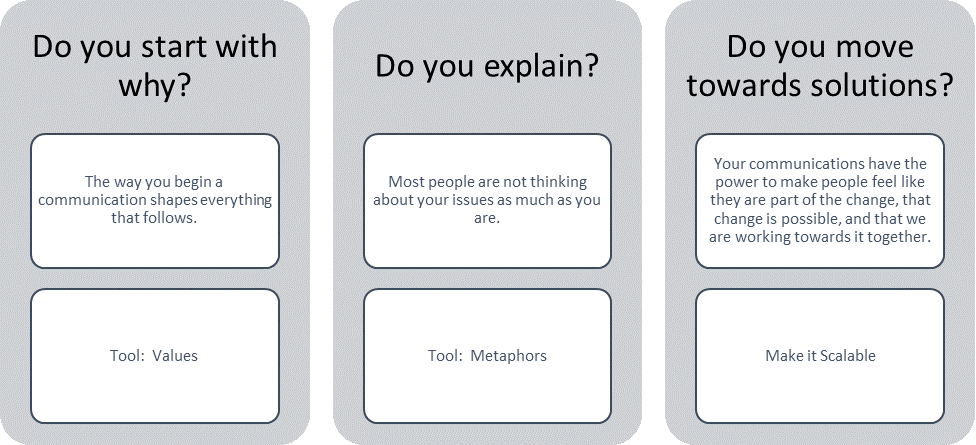
TASK 10: Using what you have learned throughout this module, complete one of the following for the audience you identified at the beginning of the module:
TASK 11: Reflect on how the voice of your community can be represented in your communication with key stakeholders. Are you including all voices? Are you aware of how power or bias might be present in reporting? Record your reflections in your course journal.Option 1: Write 1-2 paragraphs to tell your evaluation story including at least one quantitative and/or qualitative data point from your analyzed data and one anecdotal story that might illustrate your data.
Option 2: Create 3-7 slides to tell your evaluation story including at least one quantitative and/or qualitative data point from your analyzed data and one anecdotal story that might illustrate your data. If you don’t have analyzed data at this point in your process, you can use fictionalized data.
TASK 12: Part of creating culturally responsive evaluation includes engaging program participants and stakeholders in learning and decision making based on evaluation data. How might you include participants and key stakeholders in making future changes to the program? How might you tell your story to key stakeholders and partners differently to engage your program participants? Record your reflections in your course journal. -
Students mustMark as done
Pulling it All Together
TASK 13: Review the things you were hoping to learn about eeEvaluation in your course journal at the beginning of course. What have you accomplished? What do you still have questions about? Record your reflections in your course journal.
Task 14: How have your strengths and what you would like to improve in your evaluation practice changed since the beginning of the course?
Task 15: It may be helpful to think about one or two things you might tweak or change in your evaluation practice and slowly build over time. How will you continue to build and grow your evaluation practice? Record at least two action steps in your course journal. -
Opened: Tuesday, 17 January 2023, 2:00 AMStudents mustMark as doneSubmit your completed Module 5 Course Journal.
-
Opened: Tuesday, 17 January 2023, 2:00 AMStudents mustMark as done
Your final assignment for this course is to submit a Course Evaluation.
After completing the evaluation and checking the completion box, you will be able to download/print a certificate of completion for your records. The certificate will not appear until all activities and assignments are marked complete and have a passing grade.