Section outline

  • Early Childhood Banner Image

    eeCourse

    Intro to Developing High Quality Early Childhood Environmental Education Programs


    Jump to: Module 1 | Module 2 | Module 3 |  Module 4 | Module 5 | Module 6
    ____________________________________________________________________________________________

  • Welcome to the Intro to Developing High Quality Early Childhood Environmental Education Programs eeCourse. This course is designed to provide early childhood formal and non-formal educators with an introduction to environmental education, experience with early childhood environmental education activities, and the skills necessary to integrate early childhood environmental education into their classrooms, centers, family child care homes, and programs. Early childhood can extend from birth to age eight. For the purpose of this course, we primarily focus on ages three to six.


    Objectives and Expectations

    By the end of this course, you will be able to: 

    • Identify key characteristics of high-quality, early childhood environmental education programs.
    • Describe how environmental education can help address early childhood best practices, standards and/or guidelines.
    • Learn new early childhood environmental education activities for children/students.
    • Develop a plan to integrate early childhood environmental education into your classroom, center, home child care, program or organization.

    As a participant in this course, it is expected that you:

    • Commit the time required to complete all readings, assignments and assessments.
    • Complete Modules 1-6 and their associated assignments, as well as submit the final course assessment. You will have 8 weeks to complete the course upon enrollment.


    Prerequisites

    • Experience working in formal or nonformal education is not required but highly encouraged.

    Required Materials

    • Access to reliable internet and a desktop computer or laptop.
    • Any of the following: Pen, Pencil, Markers, or Crayons
    • Snack supplies (more details will be included in the modules)
    • Digital copy of Course Journal
    • Project Learning Tree’s Trees & Me (CAEE will email you an e-book link; or, you may choose to purchase a hard copy on PLT’s website)


    Completing Tasks and Assignments

    For each Module, you will record responses to prompts and complete tasks in a Course Journal. At the end of each module, you will submit your Course Journal with the relevant sections completed. 

    The Course Journal and other documents will be provided in the form of Google Docs.  You can either download as a Word document or "Make a Copy" under the File menu to edit it as your own. Assignments can be submitted as Google Docs by using the link-sharing feature. Assignments can also be submitted by attaching Word documents. If you have questions or would prefer another option, please contact Lisa Eadens at lisaeadens@caee.org.

    TIP: As you accomplish tasks within each Module, track your progress by checking the boxes next to each task. 

    CAEE can provide you with a certificate of completion for 15-hours of work, however, you must complete all assignments. 


    Grading

    • Assignments must be completed with a score of 2 as indicated on the scoring guide provided.
    • To receive a certificate of completion, you must complete all assignments and receive the scores as indicated above.


    Important Dates
    This course runs for 8 weeks, from September 30 - November 22, 2024. Although you can complete the course at your own pace, below is a recommended schedule for completing each module: 

    • Module 1 - Complete by October 9
    • Module 2 - Complete by October 18
    • Module 3 - Complete by October 30
    • Module 4 - Complete by November 8
    • Module 5 - Complete by November 15
    • Module 6 - Complete by November 22


    Meet Your Course Moderator
    Your course moderator is Lisa Eadens. Lisa is the Program Coordinator for CAEE and has been with CAEE since 2013. She coordinates CAEE's professional development trainings along with the Excellence in EE Award Program and Careers in Natural Resources Initiative. She will review and score your assignments, offer feedback and be available for the optional course meetings to answer questions.

    Get to Know the Course

    Please watch this video walk-through from the Kentucky Association for Environmental Education to learn how to navigate course modules, materials, and assignments in Moodle.


  • Description
    Research shows what educators, policymakers, and parents have recognized for years: early childhood environmental education can positively impact young children’s development.

    Objectives
    After completing this module, you should be able to:
    • Identify at least three benefits of early childhood environmental education 

    Benchmark Assessment


    Estimated Time for Completion
    1 hour


    Module 1 Tasks:

    • TASK 1: Access the Intro to Developing High Quality Early Childhood EE Programs Course Journal. You will need to either Make a Copy of this file and edit it as your own Google Doc or download it as a Microsoft Word document. Click File, Make a Copy or Download. You will record responses to prompts and complete tasks in your own version of the Course Journal throughout this course. At the end of each module, you will submit your Course Journal with the relevant sections completed.

      TASK 2: In your Course Journal write a brief reflection on the following questions:
      • How are you currently engaged in early childhood environmental education? 
      • How would you describe your current knowledge of early childhood environmental education? 
      • What are 5 questions you would like to explore regarding early childhood environmental learning? 

      TASK 3: Read the “Snapshot of Findings” section from NAAEE’s The Benefits of EE and Nature Connections in Early Childhood research study conducted in collaboration with Stanford. In your Course Journal, record answers to the following questions:
      • Identify three research findings about the benefits of early childhood environmental education that would resonate with your stakeholders (parents, administration, etc.) and why. 
      • How could you communicate or share the benefits of early childhood environmental education with your stakeholders?
    • Opened: Monday, 22 January 2024, 2:00 AM

      Submit your completed Module 1 Course Journal.

      • View scoring guide>>
      • You may upload a Word document or submit a link to a Google Doc. If you submit a link to a Google Doc, adjust the sharing settings so that it can be viewed by anyone with the link. Click the blue Share button in the top right. A new box will open, under Get Link, select 'Anyone with the link'.


  • Description
    In this module you will be introduced to environmental education for young learners, focusing on ages three through six. You will also learn about the Early Childhood Environmental Education Programs: Guidelines for Excellence. These Guidelines comprise a set of recommendations for developing and administering high-quality, early childhood environmental education programs. These recommendations provide a tool that can be used to ensure a firm foundation for new programs or to trigger improvements in existing ones. We’ve split learning about these six Key Characteristics into Module 2, which focuses on program infrastructure, and Module 3, which focuses on fostering learning.

    Objectives
    After completing this module, you should be able to:
    • Identify and understand key characteristics of high-quality, early childhood environmental education program infrastructure. 
    • Identify ways to apply these key characteristics to your programs. 

    Benchmark Assessment

    Estimated Time for Completion
    2 hours 30 minutes


    Module 2 Tasks


    • Getting to Know the Guidelines for Early Childhood Environmental Education Programs

      The Early Childhood Environmental Education Programs: Guidelines for Excellence comprises a set of recommendations for developing comprehensive early childhood environmental education programs or informing improvements in existing ones.

      TASK 1: Before looking at the Guidelines for Excellence, we want to know what you think! Record in your Course Journal your responses to the following questions:
      1. What are some of the key characteristics of a high-quality early childhood environmental educator? 
      2. What does early childhood environmental education look like? 
      3. What are some things we should keep in mind when we teach young children about their environment? 

      TASK 2: Download a free pdf of NAAEE's Early Childhood Environmental Education Programs: Guidelines for Excellence by clicking here. Read the Introduction and Summary sections pp. 2-9. Answer the questions below in your Course Journal.
      1. What is the purpose of these Guidelines? 
      2. What are some ways that early childhood environmental education differs from environmental education for older students and adults? 
      3. Does every early childhood environmental education program need to follow all of the guidelines? 
      4. What are examples of how some of your work already aligns to the Guidelines? 
      5. How else could you use the Guidelines? 

      TASK 3: Using the summary of the Guidelines on pages 8-9, compare the lists you generated in questions 1-2 of Task 1 to each of the Key Characteristics. In your Course Journal, group your ideas into each of the six Characteristics. How did the concepts you listed overlap with the Key Characteristics in the Early Childhood EE Guidelines? Were there any gaps in the concepts and ideas you listed?

      In the following tasks you will dig deeper into Guidelines 1, 5 and 6 which focus on program infrastructure.
    • Key Characteristic #1 - Program Philosophy, Purpose, and Development

      Overview: High quality early childhood environmental education programs articulate an overarching philosophy that guides all program activities. Goals and objectives state how the program meets the needs of young children and their community. This includes the following Guidelines: (1.1) Focus on Nature and the Environment, (1.2) Focus on Education of Young Children, (1.3) Culturally Appropriate Goals, Objectives, and Practices, (1.4) Environmental Literacy, Board, Staff and Providers, (1.5) Health and Safety, (1.6) Ongoing Evaluation and Assessment, (1.7) Partnerships, and (1.8) Interpersonal and Intergenerational Relationships.

      TASK 4: Read through Key Characteristic #1 (pages 10-17).

      TASK 5: In this task, we will take a closer look at Guideline 1.3 - Culturally Appropriate Goals, Objectives and Practices. Read “The Role of Culture in Early Childhood Environmental Education'' on Page 13 of the Guidelines document. Then, answer the following questions in your Course Journal:
      • What are some nature-oriented cultural traditions you might encounter in your early childhood programs? How are these similar or dissimilar to your own nature-oriented cultural traditions? 
      • How have these cultural traditions been honored? What are some other ways these cultural traditions or similar cultural traditions can be honored? 
      • How might you learn more about the cultural traditions of the children you serve? 
      • How are families seen and represented in your program? How are families invited into the learning process?

    • Key Characteristic #5 - Places and Spaces

      Overview: High quality early childhood environmental education programs provide places and spaces, both indoors and out, that are safe, enticing, comfortable, and enhance learning and development across all learning domains. This Key Characteristic includes the following Guidelines: (5.1) Spaces and Places to Enhance Development, (5.2) Natural Components, (5.3) Comfortable for both children and adults, (5.4) Maintenance and Usability, (5.5) Health, Safety, and Risk, (5.6) Environmental Sustainability.

      TASK 6: Outdoor spaces come in a variety shapes and sizes. Some are well developed for outdoor learning and play and some are not. The Natural Learning Initiative has developed best practice indicators for preschool outdoor play and learning environments. Read through the best practice indicators below:

      13 Best Practice Indicators from the Natural Learning Initiative 2021. Preschool Outdoor Play and Learning Environments Best Practice Toolkit. Natural Learning Initiative.
      1. There are 10 or more play and learning settings. 
      2. There is a looping, curvy, primary pathway for circulation and wheeled-toy use. 
      3. There is a grassy lawn for games, activities, and events for many children. 
      4. There are sufficient shady settings in addition to trees. 
      5. There is a variety of loose materials, accessible for children to play with. 
      6. There is sufficient portable play equipment, including different types of wheeled toys, accessible for children to play with. 
      7. There are sufficient gross motor activities supported by the outdoor play and learning environment. 
      8. There are sufficient trees. 
      9. There is a proportion of trees that are edible fruiting species. 
      10. There are sufficient shrubs and vines (including fruiting species), ornamental grasses, and perennial flowering plants. 
      11. There is a designated vegetable garden with sufficient produce for snacking and/or meals. 
      12. There is a covered outdoor classroom/gathering place large enough for all children in a class to use together. 
      13. There is sufficient storage for wheeled toys, portable play equipment, loose parts, and other play and learning materials. 

      Reimagining your outdoor play and learning space doesn't have to be a huge financial investment. Explore Creative Play Settings on a Budget to learn about affordable options for designing and activating your outdoor space for nature play and learning.

      OPTIONAL RESOURCES:
      • How-To Guides (ECHO Website) Winter Play 
      • Playing By the Rules Colorado - guidebook that goes through settings and looks at them through the licensing requirements, etc. 

      TASK 7: In your Course Journal, reflect on the following questions:
      • What are your reactions to the guideline’s best practice indicators? 
      • Which best practices are most important to you? 
      •  What challenges do you foresee in applying the best practices? What are potential solutions to these challenges? 
      • What creative play materials could you add?

      TASK 8: Look at the two pictures below. Each illustrates an undeveloped outdoor space that could benefit from improvements. Select one and in your Course Journal, discuss how it could be improved to provide opportunities for outdoor learning and play. (Bonus Fun: If you like, print out one of the photos and sketch the improvements you would make and annotate it towards one or more of the ten principles above. Then take a photo and insert it into your Course Journal)
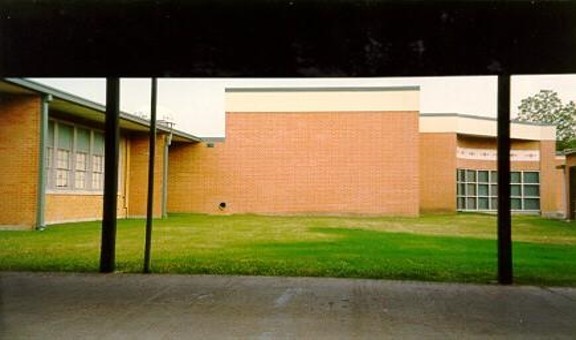
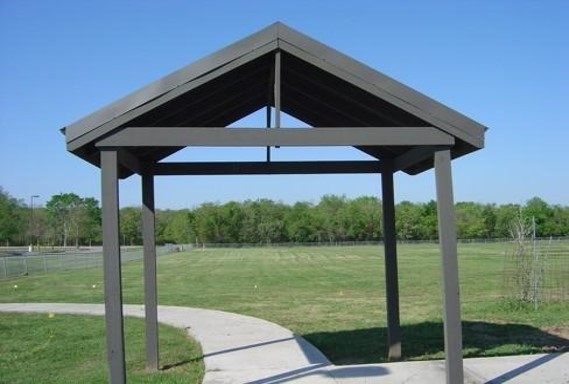
      Undeveloped outdoor space

       Undeveloped outdoor space


      TASK 9: Look at the photos below of re-designed early childhood spaces for outdoor learning from the National Wildlife Federation - Early Childhood Health Outdoors.
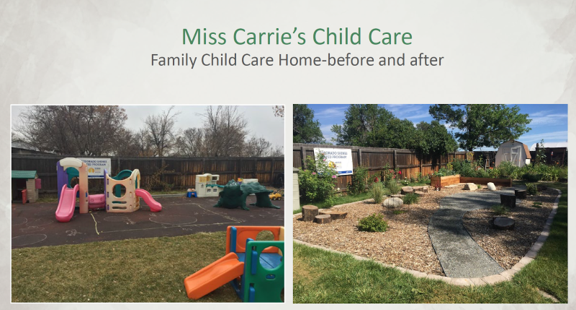
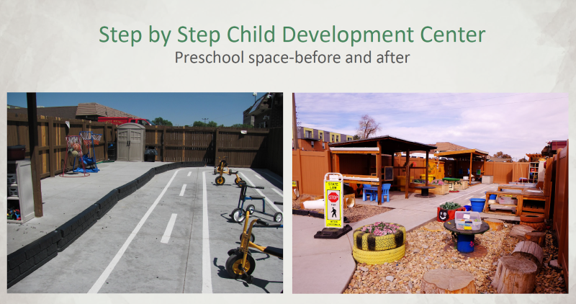
      Before and after photo

      Before and after photo


      In your Course Journal reflect on the following questions:
      • What do you like about these spaces? 
      • What elements would you like to incorporate into your own space? 
    • Key Characteristic #6 - Educator Preparation

      Overview: Effective early childhood environmental educators are able to plan and implement high-quality, developmentally appropriate programs for young children. This includes the following Guidelines: (6.1) Foundations of Early Childhood Environmental Education, (6.2) Professional Responsibilities of the Educator, (5.3) Environmental Literacy, (5.4) Planning and Implementing Environmental Education, (6.5) Fostering Learning and (6.6) Assessment and Evaluation.

      TASK 10: In this task, you will reflect on your own understanding, skills, and practices as an early childhood environmental educator.

      Complete the Early Childhood Self-Assessment then answer the following questions in your Course Journal:
      • Were you surprised by any of your responses? 
      •  What do you see as personal strengths? What understandings, skills or practices would you like to develop more? 
      • What qualities—understandings, skills, and practices of an early childhood environmental educator—would you add to this self-assessment?
    • Opened: Monday, 22 January 2024, 2:00 AM

      Submit your completed Module 2 Course Journal.

      • View Scoring Guide >>
      • You may upload a Word document or submit a link to a Google Doc. If you submit a link to a Google Doc, adjust the sharing settings so that it can be viewed by anyone with the link. Click the blue Share button in the top right. A new box will open, under Get Link, select 'Anyone with the link'.

  • Description
    In this module you will continue to explore the Early Childhood Environmental Education Programs: Guidelines for Excellence. Specifically, you will dig deeper into Guidelines 2, 3 and 4, which focus on fostering learning within programs.

    Objectives
    After completing this module, you should be able to:
    • Identify and understand key characteristics of fostering learning in early childhood environmental education programs. 
    • Identify ways to apply these key characteristics to your programs. 

    Benchmark Assessment

    Estimated Time for Completion
    2 hours


    Module 3 Tasks


    • In the following tasks you will dig deeper into Guidelines 2, 3 and 4 which focus on effective instruction within early childhood programs.


      Key Characteristic #2 - Developmentally Appropriate Practice

      Overview: Effective early childhood environmental education is designed and implemented using established developmentally appropriate practice, which is defined as “matching the learning environment, the physical set up and materials, schedule, curriculum, teaching methods to the developmental levels of children” (Oltman, 2002, p.2). This includes the following Guidelines: (2.1) Based on Research and Theory, (2.2) Authentic Experiences, (2.3) Child-Directed and Inquiry-Based, (2.4) The Whole Child.

      TASK 1: Read through Key Characteristic #2 (page 18-23), including Appendix D - Overview of Selected Theorists Important to Early Childhood Education (67-68).

      TASK 2: Read the following story then respond to the questions below in your Course Journal.

      Stephanie, Emma, and Amy Discovered Some Caterpillars in the Garden. They took turns holding them gently and then put them in a small jar. “What do they eat?” they asked a teacher. “We have a book in the classroom that will tell us. I’ll go get it,” she responded. When the teacher returned, the children had given the caterpillars a big drink—so big that they were floating and not moving. Alarmed, the children thought the caterpillars had died. The teacher helped them pour off the water and the caterpillars began to move again. The teacher explained that caterpillars only need little drinks because they are very little. Together, they looked in a field guide and found that caterpillars are vegetarians—a word the children immediately understood because one of their classmates was a vegetarian. The children gathered bits of leaves to put in the jar. The teacher in this example was responsive to children’s interests and questions, and assisted them in finding information they wanted. The teacher helped them solve their floating caterpillar problem, using it as a teachable moment.
      • Have you ever encountered a similar scene when outdoors with young children? What were the children doing? What did you do? 
      • How did the teacher in this story encourage the children’s learning? What else might the teacher do to encourage the children’s learning? 
      • How can adults enhance children’s opportunities to discover their environment both indoors and outdoors? 
      • What learning theories or approaches relate to this story? Be as specific as possible. (See Appendix D - Overview of Selected Theorists Important to Early Childhood Education on pages 67-68 for reference).
    • Key Characteristic #3 - Play and Exploration

      Overview: Early childhood environmental education programs ensure opportunities for nature-based play and exploration, both indoors and outdoors. Play and exploration are natural, spontaneous acts in which all children engage. This includes the following Guidelines: (3.1) Use of Natural World and Natural Materials, and (3.2) Play and the Role of Adults. Read more about these on pages 25-29.

      TASK 3: Play is an essential part of early childhood education. Read the box about the Benefits of Play on page 26. In your Course Journal, describe which benefits resonate the most with your program.

      TASK 4: Think about how play is facilitated. As adults, what are some ways you can create opportunities for play, especially play with natural objects and play in the outdoors?

      TASK 5: Exploration outdoors can be seen as messy and dirty and potentially dangerous. Imagine that some of the caregivers on your advisory board resist the idea of taking children outside to play. Make a list of the barriers they might express. Then, describe ways of reducing or eliminating those barriers or risks. How could you make connections to reduce those barriers and collaborate with other stakeholders? Be as specific as possible.
    • Key Characteristic #4 - Curriculum Framework for Environmental Literacy

      Overview: In effective early childhood EE programs young children are provided opportunities to explore their environment and develop knowledge and skills. Through the use of an environmental learning curriculum framework, educators intentionally foster growth and development across social-emotional, cognitive, physical, and language domains. The curriculum framework should be designed and implemented to be consistent with developmentally appropriate practices (key characteristic 2). This learning will lead, as the child matures into adulthood, to environmental literacy. Guidelines for this Key Characteristic include: (4.1) Social and Emotional Growth, (4.2) Curiosity and Questioning, (4.3) Development of Environmental Understandings, (4.4) Skills for Understanding the Environment, (4.5) A Personal Sense of Responsibility and Caring and (4.6) Physical Health and Development.

      TASK 6: Scroll through these slides to learn more about the Guidelines in Key Characteristic #4.

      TASK 7: In your Course Journal, complete the table by reviewing each Guideline and underlying indicators (the bullet points below each Guideline) and making a list of 3-5 things that you do well and of 3-5 new things that you would like to use in your early childhood program. If you are developing a new program, focus on the strengths that you envision bringing, and 3-5 areas you would want to include but need to build new skills.
    • Reflection

      In this final section, take some time to reflect on all six key characteristics and your own early childhood environmental education programs.

      TASK 8: In your Course Journal, answer the following:
      • Thinking about all 6 Guidelines broadly or collectively, imagine a rating scale of 0-7 where 0 would be not developed at all, the middle of the scale would be partially developed, and a seven on the scale would be fully developed and meeting all parts of the guidelines. Where do you think your program is at this point in time? Why do you give yourself that rating? 
      • Which of the 6 Characteristics is the easiest to incorporate in your program? Why? 
      • Which of the 6 Characteristics is the hardest to incorporate in your program? Why? 
      • What is one concrete action you could take in the next six months to more fully address these guidelines?

      OPTIONAL: Complete the Early Childhood Environmental Education Rating Scale

      A companion publication, the Early Childhood Environmental Education Rating Scale, provides a collaborative tool for educators and others to discuss their early childhood environmental education program goals, consider strengths and areas of needed improvement, and chart a future direction for program development. Whether you work with a center-based child development or family day care center, this tool can help you make needed improvements in the quality of activities, experiences, interactions, and instruction concerning the world of nature and its value in society. Environmental education centers, too, may benefit through improvements in curriculum that better respond to the abilities, interests, learning styles, and motivations for learning of young children.
    • Opened: Monday, 22 January 2024, 2:00 AM

      Submit your completed Module 3 Course Journal.

      • View Scoring Guide >>
      • You may upload a Word document or submit a link to a Google Doc. If you submit a link to a Google Doc, adjust the sharing settings so that it can be viewed by anyone with the link. Click the blue Share button in the top right. A new box will open, under Get Link, select 'Anyone with the link'.

  • Description
    This module provides an introduction to and activity experiences from Project Learning Tree’s Trees and Me.

    Objectives
    After completing this module, you should be able to:
    • Demonstrate an understanding of the components and applicability (to classrooms, centers, home child care, or programs) of Project Learning Tree’s Trees and Me 
    • Implement activities from Project Learning Tree’s Trees and Me into classrooms, centers, home child care, or programs. 

    Benchmark Assessment

    Estimated Time for Completion
    3 hours

    Module 4 Tasks


    • Introduction to Project Learning Tree’s Trees and Me

      Early childhood environmental education is an important component for fostering a lifelong connection to the natural world. There are many resources available to help bridge that connection. You can find a comprehensive and searchable list of Early Childhood Outdoor and Environmental Learning Resources at https://naturalstart.org/resources. Key Characteristic #4 - Curriculum Framework for Environmental Literacy (explored above) is a framework that can help you to evaluate and select appropriate resources across social-emotional, cognitive, physical, and language domains. This framework along with numerous other materials contribute to a diverse catalog of early childhood resources available for educators.

      One curriculum resource is Project Learning Tree’s Trees & Me activity book. Trees & Me contains hundreds of ideas for fun, easy-to-do, hands-on experiences to connect young children to nature, with a focus on trees and forests. Through both outdoor and indoor activities, children explore nature through their senses, experience trees throughout all four seasons, and connect with their community. Each activity makes explicit connections with early learning standards in science, English language arts, math, and social studies, as well as the National Association for the Education of Young Children and Head Start.

      PLT's Early Childhood program is co-sponsored in Colorado by CAEE, and the Colorado State Forest Service. Learn more about PLT offerings in Colorado at https://coloradoplt.org.

      TASK 1: You should have received an email directly from PLT with instructions to access your PLT Trees & Me E-Book. Read the Project Learning Tree's Trees and Me Introduction (pgs 3-5). In your Course Journal, respond to the following:
      • What key features of the Guide do you think will be most useful for you?
    • PLT Early Childhood Activity Experience - Sounds Around and The Shape of Things

      Experience the activities Sounds Around and The Shape of Things through hands-on demonstrations.

      TASK 2: On a piece of paper, draw all the shapes you can think of. Be sure to leave space near each shape as you may wish to write next to the shapes during the next task.

      TASK 3: Take a nature walk (NOTE - if it’s inclement weather or not possible to go outside - this could be done from a window by looking outside and opening the window to hear the sounds). During your nature walk you'll be focusing on shapes and sounds. While on your nature walk either take pictures or sketch or list on your paper shapes you see that match the ones you drew (they don't have to match perfectly just close) and note any new shapes you find. On the backside of your paper also write down any sounds that you hear.

      TASK 4: In your Course Journal, upload pictures and/or notes about shapes and sounds from your nature walk. You may even choose to upload a picture of the paper that you took notes on.

      TASK 5: Choose one sound from your nature walk that you would like to try and recreate either using your voice or body or by using an object or instrument. Recreate the sound. What other sounds might you encourage your learners to recreate in your area? Add three additional rows to the table below in your Course Journal.
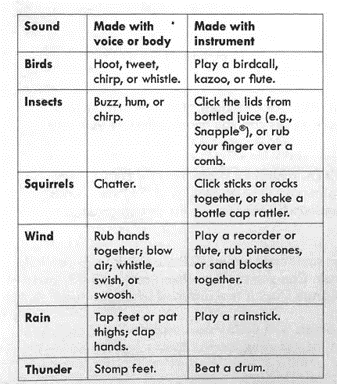
      Sounds Around activity table


      TASK 6: Read the full activities for Sounds Around and The Shape of Things in your PLT Trees and Me Book.

      TASK 7: In your Course Journal, debrief the components of the activity by answering the following questions:
      • How would you modify or adapt these activities for your teaching? 
      • Examine and record how these activities can be made inclusive for all learners.
    • PLT Early Childhood Activity Experience - Fall for Trees, Evergreens in Winter, Best Buds, or My Tree and Me

      Section 2 of the PLT Trees and Me includes activities related to experiencing trees through different seasons.

      TASK 8: Read one of the section two activities: Fall for Trees, Evergreens in Winter, Best Buds, or My Tree and Me.

      TASK 9: In your Course Journal, record which activity you chose to read through. Select one part/section of the activity to try out and complete. Record what you did in your Course Journal (via any of the following: video, photos, notes, art project, etc.)
      *EXAMPLE: In the activity Fall for Trees you could choose to complete the "Create dried leaf art" section of the activity.

      TASK 10: In your Course Journal, record your answers to the following reflection questions. Debrief the components of the activity:
      • How would you modify or adapt this lesson for your teaching? 
      • How would you implement this activity into your existing classroom, center, home child care, or program's schedule/lesson plans? 
      • Examine and record how this activity can be made inclusive for all learners. 

      TASK 11: Snack Showcase! - Celebrate with snack time by making the snack from the activity. Upload a picture(s) of your snack in your course journal.

      TASK 12: Growing up Wild is another curriculum resource you can use with early childhood learners. Developed nationally by Project WILD, this early childhood education curriculum builds on children’s sense of wonder about nature and invites them to explore wildlife and the world around them. Review this sample activity, “Fishing Fun”.

      TASK 13: In your Course Journal, record your answers to the following reflection questions. Debrief the components of the activity:
      • How would you modify or adapt this lesson for your teaching? 
      • How would you implement this activity into your existing classroom, center, home child care, or program's schedule/lesson plans? 
      • Examine and record how this activity can be made inclusive for all learners. 

      TASK 14: There are a wide variety of resources available for early childhood learners. Check out the resource list available from Natural Start. Identify two you might want to explore further and why they might be relevant to your site and/or learners.

    • Opened: Monday, 22 January 2024, 2:00 AM

      Submit your completed Module 4 Course Journal.

      • View Scoring Guide >>
      • You may upload a Word document or submit a link to a Google Doc. If you submit a link to a Google Doc, adjust the sharing settings so that it can be viewed by anyone with the link. Click the blue Share button in the top right. A new box will open, under Get Link, select 'Anyone with the link'.

  • Description
    Standards define what a learner needs to know and be able to do. Several different early childhood standards are available. This module provides overviews of each set of standards and how you can meet standards with early childhood environmental education programs.

    Objectives
    After completing this module, you should be able to:
    • Identify early childhood standards and/or guidelines that support your work. 
    • Utilize correlation tools to correlate activities to the appropriate standards. 
    • Correlate at least one activity to Colorado State Academic Standards. 

    Benchmark Assessment

    Estimated Time for Completion
    1 hour 30 minutes

    Module 5 Tasks


    • Overview of Early Childhood Standards
      Several different early childhood standards exist. Some standards are focused more on the program, others the curriculum, and still others focus on learning content. Different Standards include:

      • The National Association for the Education of Young Children (NAEYC): NAEYC has set 10 standards that define what it believes all early childhood programs should provide, as outlined in NAEYC Early Learning Program Accreditation Standards and Assessment Items. They offer accreditation to early childhood education programs that meet specific standards in education, health, and safety. To achieve accreditation, early childhood programs volunteer to be measured against these national standards.

      • NAAEE Early Childhood Guidelines for Excellence: You explored these guidelines in Modules 2 and 3. 

      • Natural Start Alliance Professional Practices: NSA has published the Nature-Based Preschool Professional Practices Guidebook, which identifies professional practices important in programs where children are engaged in nature-based play and learning. The practices are organized into four areas of practice: teaching, environments, safety, and administration.

      • Head Start: Head Start is a U.S. federal program with the overall goal of readying young children for school. It offers educational, health, nutritional, and social services to young children that enhance social and cognitive development. The Head Start Child Outcomes Framework provides long-term goals for early childhood programs connected with Head Start, and is a helpful resource for anyone involved in early childhood education. Head Start’s Early Learning Outcomes Framework outlines what early learners should be able to do in each of five essential learning domains including: Approaches to Learning, Social and Emotional Development, Language and Literacy, Cognition, and Perceptual, Motor, and Physical Development.

      • NGSS, COMMON CORE, and C3 FRAMEWORK: These Standards provide nationally accepted academic benchmarks for science (Next Generation Science Standards), English language arts (Common Core—ELA), mathematics (Common Core—Math), and social studies (College, Career, and Civic Life Framework) for K-12 grade.

      • Colorado Early Learning Guidelines: The Colorado Early Learning and Development Guidelines describe the trajectory of children’s learning and development from birth to 8 years old in Colorado. They include a broad description of children’s growth to ensure a holistic approach to creating positive early childhood environments. The Guidelines are organized in the following domains: physical development and health, social development, emotional development, language and literacy development, approaches to learning, and cognitive development. The Guidelines span ages birth to third grade.

      • Colorado Academic Standards: Colorado Academic Standards define what learners should know and be able to do from Prek-12th grade.


      TASK 1: In your Course Journal answer the following questions: 

      • Do you use any of these or other standards in the work that you do? If yes, which standards do you use? 
      • Which new learnings might you be able to apply from utilizing an additional set of standards? Why? 


      TASK 2: Skim through the Project Learning Tree’s Connecting PLTS Trees & Me to Early Learning Benchmarks. Answer the following questions in your Course Journal: 

      • Note three observations you made when looking through the various correlations. 
      • What was something new that you learned when reviewing these standards? 
      • How could you see yourself using this document in the work that you do? 


      TASK 3: Visit the Colorado Department of Education’s Online Searchable Academic Standards website. Select a content area of your choice. Select a grade level between Preschool and 3rd Grade. Review the Grade Level Expectations shown. (Grade Level Expectations are the articulation (at each grade level) of concepts and skills of a standard that indicate a student is making progress towards mastery.) In your course journal, describe how you might meet two of the grade level expectations listed using either the Trees and Me Materials or Growing Up Wild.

    • Opened: Monday, 22 January 2024, 2:00 AM

      Submit your completed Module 5 Course Journal.

      • View Scoring Guide >>
      • You may upload a Word document or submit a link to a Google Doc. If you submit a link to a Google Doc, adjust the sharing settings so that it can be viewed by anyone with the link. Click the blue Share button in the top right. A new box will open, under Get Link, select 'Anyone with the link'.

  • Description
    The culminating assignment for this course will be the development of an action plan/teaching unit that outlines ongoing opportunities for the integration of environmental education (EE) into the classroom, center, home child care, or program over time. The action plan will contain three learning experiences from Project Learning Tree’s Trees and Me, Growing Up WILD or other selections of your choice.

    Objectives
    After completing this module, you should be able to:
    • Implement environmental education in your classroom, center, home child care, or program via the action plan you’ll create during this module. 
    • Utilize the action plan that you develop as a model and jumping off point for creating further environmental education opportunities to be implemented in the future for a sustained long-term environmental education focus. 

    Benchmark Assessment


    Estimated Time for Completion
    2 hours


    Module 6 Tasks

    • EE Action Plan/Teaching Unit Development

      In this module you will have the opportunity to create an action plan/teaching unit in order to help with implementation of environmental education.

      TASK 1:  Free exploration, learning centers or stations are a key component of early learning settings.  Read more about them in "Natural Wonders" before you put together your plan (PDF pages 47-54).

      TASK 2: Develop an action plan containing three learning experiences from Project Learning Tree’s Trees and Me, Growing Up Wild, or another curriculum of your choosing. Use the provided action plan in your Course Journal to complete your assignment.

      TASK 3: Self-Assessment

      The goals of this course were to:
      • Identify key characteristics of high-quality, early childhood environmental education programs 
      • Describe how environmental education can help address early childhood best practices, standards and/or guidelines
      • Learn new early childhood environmental education activities for children/students
      • Develop a plan to integrate early childhood environmental education into your classroom, center, home child care, program or organization. 

      Use the table in your Course Journal to assess your understanding of each of the goals.

    • Opened: Monday, 22 January 2024, 2:00 AM

      Submit your completed Module 6 Course Journal.

      • View Scoring Guide >>
      • You may upload a Word document or submit a link to a Google Doc. If you submit a link to a Google Doc, adjust the sharing settings so that it can be viewed by anyone with the link. Click the blue Share button in the top right. A new box will open, under Get Link, select 'Anyone with the link'.

    • Opened: Monday, 22 January 2024, 2:00 AM

      Your final assignment for this course is to submit a Course Evaluation

      After completing the evaluation and checking the completion box, you will be able to download/print a certificate of completion for your records.  The certificate will not appear until all activities and assignments are marked complete and have a passing grade.