Module 4: Learning Through Observational Science
Section outline
-
Description
In this module, you will deepen your own relationship with the world around you and explore what it means to be a good relative to the environment. Everyone was once connected to the earth, but for most, disconnection has occurred. Native peoples are redeveloping their connections and this module provides a process for relearning your connection with your students.
Objectives
After completing this module, you should be able to:- Support your students in developing relationships with the world around them
- Explore with your students what it means to be a good relative to the world around them
- Describe and develop observational strategies that utilize approaches outside of Western Science
Benchmark Assessment- Completion of Module 4 Course Journal entries
- View Scoring Guide>>
Estimated Time for Completion
3 HoursModule 4 Tasks:
-
Students mustMark as done
Understanding Your Relationship with the Environment
TASK 1: In your Course Journal, write one paragraph describing the following:
-
Describe the environment you live, work, and play in.
-
How would you describe your relationship with the environment?
TASK 2: Watch the following videos of Scott Frazier, Santee, and an enrolled Crow Tribal Member, Abby Ybarra, Yaqui-Tohono O’Odham, Renee Sans Souci, Omaha, as they describe their relationship to the environment. Record in your Course Journal any similarities or differences that you noticed in how you described your relationship to the environment.
-
-
Students mustMark as done
Building Knowledge through Observation
Making observations in nature brings us into a relationship with whatever it is that we are observing. During a visit with the Grand Canyon Trust in 2016, Dr. Robin Wall Kimmerer, scientist, professor, enrolled member of the Citizen Potawatomi Nation, and bestselling author of "Braiding Sweetgrass: Indigenous Wisdom, Scientific Knowledge, and the Teachings of Plants," explained that Traditional Ecological Knowledge isn't just the result of observing the natural world. She said, "To me, the power and the promise of traditional knowledge is that traditional knowledge, instead of excluding emotion and spirit, invites it in," (Grand Canyon Trust, 2023). During the next set of tasks, you will spend time observing and deepening your relationship with nature.
TASK 3: Find a place where you can watch the sunrise. Spend at least 10 minutes making observations using all your senses. What do you hear, smell, feel, and see? What does it remind you of? What feelings does it invoke? In your course journal, record your observations and feelings. Where did you watch the sunrise? What learnings could you take from your experience? What learnings might you have if you watched the sunrise every day for a year?
TASK 4: In your Course Journal, describe the weather in as much detail as you can. After you have written a description, go outside and spend at least 5 minutes making observations about the weather. What does it feel like? What do you see? Are there smells or sounds that reflect the weather? Re-write your description of the weather without using any Western Science language/measurements (i.e. How can you measure temperature without using degrees?). What is your relationship with the weather?
-
Students mustMark as done
TASK 5: Go on a 15 minute walk nearby your home or workplace. Using all your senses, make observations along your walk. Note the starting point of your walk and the end point. What you hear, smell, feel, and see? What landmarks do you pass? What do the landmarks you pass remind you of? When you return back to your starting point, draw a map depicting your journey without using words. Take a picture of your map and upload it into your Course Journal. What on your map would be most helpful to help someone travel the same route? OPTIONAL: Give your map to a colleague or family member. Were they able to follow the same path? What observations did you record that were the most helpful in sharing the knowledge of where you went?
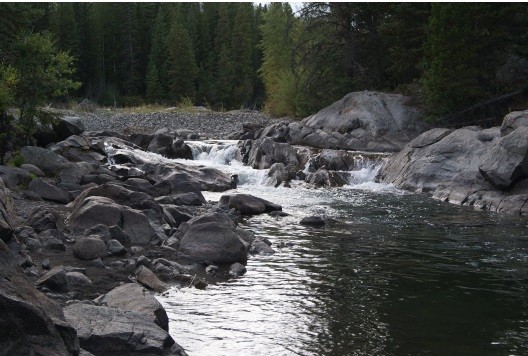
Clark’s Fork of the Yellowstone River, photo credit: Scott Frazier
TASK 6: Find a time and place where you can sit and watch the sunset near your home or workplace. Spend at least 10 minutes making observations. Record in your Course Journal: What observations did you make? How did you know when it was time for the sun to set? Did you use a clock? Has your relationship with the environment around your home and office changed in any way as a result of participating in these activities?
TASK 7: Record in your Course Journal, how might it be beneficial to your students to engage in making observations and building relationships with nearby nature. How might you use these or similar activities with students? -
Students mustMark as done
Gratitude and Reciprocity
TASK 8: Go outside. Find four things that are important to water. Pick one of these things and describe how you selected it and why they are important. What can you learn from them? Explain how you did or could have shown gratitude to the thing you selected for the learning they provided. (Activity created by Scott Frazier, Project Indigenous).
TASK 9: Read the following quotes from Robin Wall Kimmerer’s book, “Braiding Sweetgrass: Indigenous Wisdom, Scientific Knowledge and the Teachings of Plants” that describe a worldview of reciprocity.
“In the Western tradition there is a recognized hierarchy of beings, with, of course, the human being on top—the pinnacle of evolution, the darling of Creation—and the plants at the bottom. But in Native ways of knowing, human people are often referred to as “the younger brothers of Creation.” We say that humans have the least experience with how to live and thus the most to learn—we must look to our teachers among the other species for guidance. Their wisdom is apparent in the way that they live. They teach us by example. They’ve been on the earth far longer than we have been, and have had time to figure things out.”
“Paying attention is a form of reciprocity with the living world, receiving the gifts with open eyes and open heart.”
“Know the ways of the ones who take care of you, so that you may take care of them.
Introduce yourself. Be accountable as the one who comes asking for life. Ask permission before taking. Abide by the answer.
Never take the first. Never take the last. Take only what you need.
Take only that which is given.
Never take more than half. Leave some for others. Harvest in a way that minimizes harm.
Use it respectfully. Never waste what you have taken. Share.
Give thanks for what you have been given.
Give a gift, in reciprocity for what you have taken.
Sustain the ones who sustain you and the earth will last forever.”
TASK 10: The presence or absence of macroinvertebrates can help indicate the quality of water in streams, ponds, and other waterways. Certain species can only survive in water that is free of pollutants whereas you might find more of other species in polluted water. Imagine you are studying water quality with students and collecting macroinvertebrates from a nearby stream. How might you incorporate gratitude and reciprocity into the learning experience?
-
Students mustMark as done
Summing It Up
TASK 11: Read the lesson, “I notice, I wonder, It reminds me of '' and the accompanying background information from the Beetles Project. In your Course Journal, answer the following questions:
How does this lesson help students develop a relationship with nature?
In what ways does this lesson incorporate traditional ecological knowledge? Are there other opportunities for students to engage in other ways of knowing?
How might you incorporate more opportunities for utilizing Traditional Ecological Knowledge in this lesson?
How might you use a lesson like this with students?
-
Opened: Tuesday, 1 October 2024, 1:00 AMStudents mustMake a submission
Submit Module 4 Course Journal:
- Upload your COURSE JOURNAL with MODULE 4 Tasks completed. You may either upload it as a Word document or share a link to your Course Journal Google Document (Be sure that you set the Sharing Setting to “Anyone with the link” and the role of “Commenter”)