Why evaluation?
Evaluation is a powerful tool for organizations to understand their program impacts. Evaluation is all about learning: It is an opportunity to learn about participants’ experiences, the needs of community partners, and whether the program is effective in achieving its intended outcomes. It is the practice of collecting, analyzing, and interpreting data to determine the quality and impact of a program; using data to improve programming; and sharing knowledge with the broader environmental education field.
What is this course about?
A primary goal of this course is to give participants the skills to develop an evaluation plan that goes beyond the satisfaction survey many providers use. The best evaluation plan is intentionally connected to program goals and created and implemented in collaboration with the program audience. By giving more environmental educators the tools to carry out meaningful evaluations, we can improve our efforts to build a healthier and more equitable future.
Who is this course for?
This course is intended for anyone working in or adjacent to environmental education. The course will cover evaluation basics and is intended for practitioners with no evaluation experience as well as those with many years of experience. If you are someone with evaluation experience, the course content may help you think of evaluation differently and give you new ideas.
How was this course made?
This course was designed by EE practitioners with strong backgrounds in evaluation. The design team includes Lauren Pyle, Michelle Pearce, Sue McGuire, and Ashlyn Teather. Lauren and Michelle both work for Environmental Educators of North Carolina and have multiple years of experience coordinating, designing, and moderating professional learning for environmental educators. Michelle also provides evaluation coaching for EENC members. Sue has years of EE experience and individually evaluating programs. Ashlyn has a masters degree in EE and was previously involved in the eeVAL project. The design team is happy to share what we have learned throughout our careers from our peers, teachers, researchers and lived experience in this course.
The flow of the course follows the evaluation elements developed by eeVAL, a evaluation resource developed in partnership with the North American Association for Environmental Education (NAAEE). The eeVAL team consists of researchers, evaluators, funders, and practitioners who aim to increase the culture and capacity of evaluation in EE.
The eeVAL elements that shape the flow of our modules are rooted in culturally responsive and equitable evaluation (CREE). You will learn more about CREE in Module 1.2. There are several important points to make about this context. First, CREE has a long history of scholarship, and new ideas on how to best conduct evaluations are often emerging. Second, the designers of this course are not experts in conducting culturally responsive and equitable evaluations. They also do not claim that this course is CREE, nor would the eeVAL team say that eeVAL is CREE. However, they do recognize the importance of CREE and believe an evaluation that listens to, works with, and learns from their program participants and larger community will result in the most meaningful information that can be used to improve EE programming. Therefore, this course embraces the values of culturally responsive and equitable evaluation in EE (the eeVAL Values).
For understanding how CREE can be practiced within the EE field, this course draws understanding from the team of scholars behind eeVAL including Dr. Karyl Askew, Dr. Steven Braun, Dr. Jean Kayira, and Dr. Libby McCann. Additional scholars whose work was influential in the design of this course include Dr. Stafford Hood, Dr. Rodney K. Hopson, and Dr. Karen E. Kirkhart. There are many other scholars, practitioners, teachers, mentors, and influential people that have shaped the scholarship behind CREE and best practices for learning with communities through evaluation. This is a constantly evolving approach to evaluation and community engagement, though, and ideas about best practices may change with additional research.
It should be noted that the readings in this course are pulled from many resources, all of which are linked and/or available for download. Often you are required to read only certain pages, as indicated in the modules, but access to the full resource is provided when possible. Lastly, when activities in this course come from other sources, they are credited as such.
Objectives and Expectations
By the end of this course, you will
- Be able to identify evaluation questions that are relevant to your program and your program partners.
- Be able to design a logic model and construct a theory of change for your program.
- Understand important evaluation terminology and become more comfortable with evaluation components.
- Gain familiarity with a variety of possible outcomes related to EE programs and decide which are relevant to your program(s).
- Design an evaluation plan that is culturally responsive, fits within your program design, and is achievable by your team.
- Become familiar with a variety of evaluation resources.
- Better understand the impacts of your work and feel more confident in sharing those impacts with others.
As a student of this course, you are expected to
- Commit the time required to complete all readings, assignments, and assessments.
- Enter appropriate answers and responses in the course assignments or through submissions of art, poetry, video, or recorded spoken word addressing the same topics.
- Make every effort to be present for synchronous meetings. You will need to log in through a computer to view shared screens during the live calls. We strongly encourage you to use video during these live conversations if you have that capability, but at a minimum, you are expected to participate in audio conversations. If your computer doesn’t have a microphone, you must call in by phone rather than using the computer's audio.
- Complete Modules 1-5 and their associated assignments, as well as submit the final course assessment. You will have seven weeks to complete the course upon enrollment.
Prerequisites
- Experience working in environmental education is not required but highly encouraged. Many of the resources shared will be most relevant to those working in and adjacent to environmental education.
- Both formal and nonformal educators are welcome; however, many of the resources provided will likely be most relevant to nonformal audiences.
- During this course, you will be creating an evaluation plan. We recommend coming into this course with a specific program or lesson you want to elevate (it can be a past, current, or future program) to get the most out of this activity. However, that is not required, and your evaluation plan can be completed with an example program that will be provided.
Grading
- Periodic assessments throughout each module must be completed with at least a score of 2 as indicated on the scoring rubric provided.
- This course has TWO required calls. You must participate in both calls to successfully complete the course. If you have a last-minute emergency or surprise scheduling conflict that prevents you from attending, contact your moderator as soon as possible.
- To receive a certificate of completion, you must complete all modules and receive the scores as indicated above.
Pacing Guidelines
While you may work at your own pace, we suggest adhering to the following schedule to complete all modules on time.
- Module 1: 1 Week
- Zoom Call Monday Aug 3, 3pm - 4pm
- Module 2: 2 Weeks
- Module 3: 1 Week
- Module 4: 2 Weeks
- Zoom Call Monday Sept 7, 3pm - 4pm
- Module 5: 1 Week
Throughout the course, you will see deadlines for assignments and activities that correlate to these pacing guides. All work must be completed by the final course deadline. There is no penalty for submitting assignments on dates other than the suggested pacing dates, as long as submissions are before the course deadline. You are always welcome to work ahead. Refer to the Course Calendar for the pacing dates of the current course.
Meet Your Course Moderator
You will have one moderator for this course who reviews your assignments and provides scores and feedback.
Michelle Pearce (she/her), Program Coordinator, EENC. Michelle is a certified North Carolina Environmental Educator and has a Master's of Arts in Education with a focus in Science Education. Her passion is empowering educators with tools that will help them provide equitable and inclusive learning. She is a long-time member of EENC and has served on the Board of Directors as Membership Chair, Education Chair, and as the 2016 President. If you have any questions during the course, please contact Michelle at programs@eenc.org.
Logging Your Progress
As you complete activities, there are a few ways to document your progress.
- For tasks such as videos, readings, Padlets, etc., you will see a square box with solid borders to the right of each task. Once you've completed the task, manually click that box to document your progress. This helps the moderator keep track and will also help you know where you left off when you sign back in.
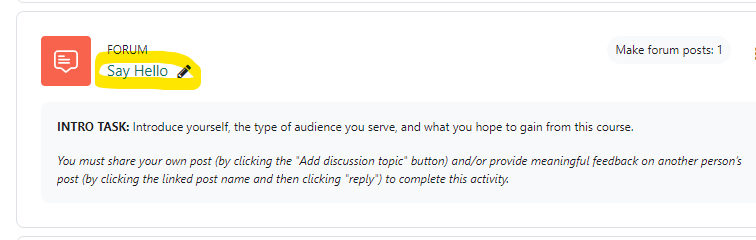
- Next to the forums, you'll see a square box with dashed borders. For these to be marked as complete, you need to submit the appropriate number of posts/replies as described in the directions. Once you have done so, the box will automatically be checked.
- At the end of each module, you will submit your course journal and Evaluation Plan Worksheet as an assignment. Turn in the entirety of the Evaluation Plan Worksheet at the end of each module, including what you completed for previous modules, what you completed for the current module, and sections you have yet to complete. It is recommended you turn in the Evaluation Plan Worksheet as a file (Word Document, Google Doc, or PDF) each time. Once you upload your file or enter a link/text in the provided box, it will mark the module as complete and allow you to move to the next section.
Checking Your Grades
The moderator will be scoring assignments on a weekly basis. While you need to receive a score of 2 or higher on every module, you can continue on to the next module before your journal and Evaluation Plan Worksheet is graded.
As your course assignments are graded, you will receive notifications through Moodle. You can also view your scores and feedback from the moderator by clicking the Grades tab to the left. If you wish to add more information/complete more tasks after a module is scored, you can re-submit previous module journals for the moderator to update your score.