Module 1 - Practices in Career Development for Teens
Section outline
-
Description:
How do we help students develop the skills needed to pursue green and environmental careers? Module 1 will introduce you to several resources on work-based education, career and technical education (CTE) and Colorado essential skills and to help get you thinking about ways you can incorporate skill development into your programming.Objectives:
After completing this module, you should be able to:
- Identify where your work falls on the work-based learning continuum
- Describe and give examples of ways to engage students in developing post secondary workforce skills
Assessment:
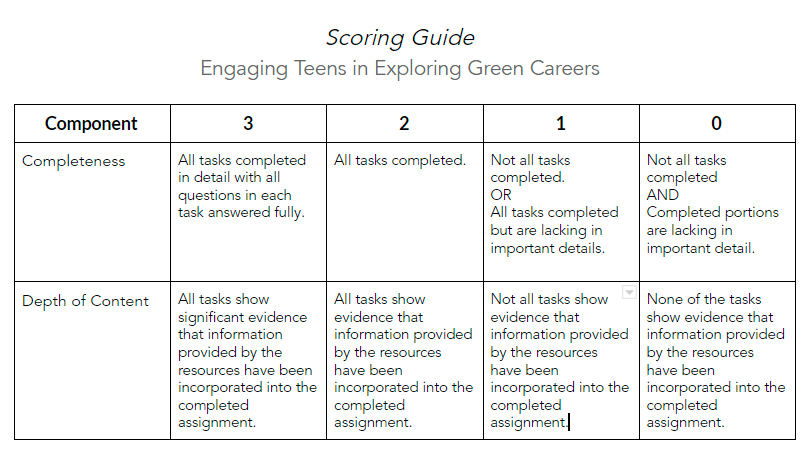
- Submit Module 1 Course Journal and earn a score of at least 2.
- View Scoring Guide>>
(Estimated module length: 1 hr 15 min)
Module 1 Tasks
-
Students mustMark as done
Work-Based Learning Continuum
The Colorado Department of Education defines work-based learning as a continuum of activities that occur, in part or in whole, in the workplace, providing the learner with hands-on, real world experience. It combines skill development with training opportunities and is a key strategy in Colorado for developing talent and preparing Coloradans for the workforce.
TASK 1: Create a personal copy of the Course Journal.
Access the template Course Journal. Next, either Make a Copy of this file to edit as your own Google Doc or download it as a Microsoft Word document. Click File > Make a Copy or Download. You will record responses to prompts and complete tasks in your own version of the Course Journal throughout this course. At the end of each module, you will submit your Course Journal with the relevant sections completed.
TASK 2: Review Colorado’s Work-Based Learning Continuum (see larger version here). In 3-6 sentences each, answer the questions below in your Course Journal.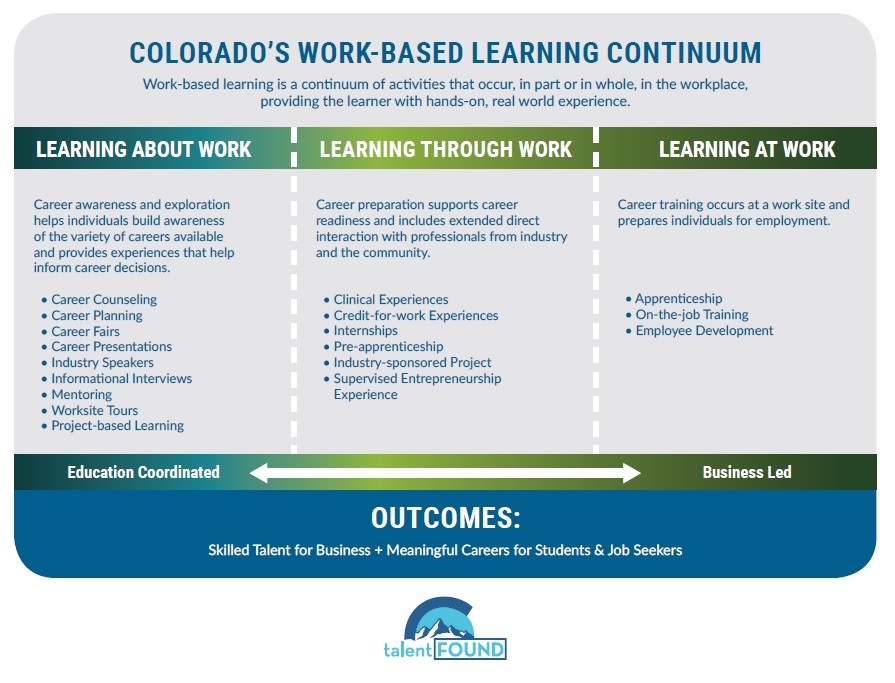
- Where does your work or the work of your organization currently fall on the continuum?
- What is your organization currently doing to engage teens in career exploration?
- What would you like to be doing?
- Where does your work or the work of your organization currently fall on the continuum?
-
Students mustMark as done
Building Student Skills
In 2008, Colorado passed legislation (Senate Bill 08-212) that requires the State Board of Education to adopt content standards that prepare students for the 21st century workforce and for active citizenship upon receiving a high school diploma. In addition to the requirement that students meet those content standards, students must also develop and demonstrate skills essential for success in professional life. Many of these skills can be met through career exploration and development programming.
TASK 3: Watch the video below which introduces practices and resources for supporting teens in career development. Then, in your Course Journal, write a short paragraph reflecting on your areas of strength and areas of opportunity that you see for your work in each of the different components described in the video.
TASK 4: Refer to the list of Post Secondary and Workforce Readiness Skills (also called Essential Skills), which were updated in 2023, in the image below (read more about them in this report) and complete the table in your Module 1 Course Journal by filling in a challenge that you or your organization currently faces or could face in incorporating development of each skill into your programming and one or more ideas you have for how you could overcome those challenges.

-
Students mustMark as done
Supporting Work-Based Learning
TASK 5: The following tools and resources are particularly useful for career influencers who host work-based learning experiences like internships or apprenticeships. Select one of these resources to read that is relevant to your work:Work Based Learning Toolkit - Explore one or more resources in this toolkit, which include an Employer Guide for a Successful Internship, an Employer’s Guide to Work-Based Learning Activities, Making Youth Employment Work: Essential Elements for a Successful Strategy, Promising Practices in Work-Based Learning for Youth and more!
Meaningful Career Conversations - This resource consists of career conversation starters and conversational prompts that align to each of the college- and career-readiness standards. Employers and industry-based partners can use these conversation starter prompts for multiple purposes: (1) interviewing candidates for apprenticeships, internships or job openings; (2) mentoring students or new employees; and (3) promoting professional growth and development during formative and summative assessment (e.g., performance evaluations and job coaching sessions).
Colorado Career Conversations - The purpose of the Colorado Career Conversations Training Project is to provide free, high-quality, professional development to individuals throughout the state who are positioned to have career conversations with students, job seekers, clients, or others who may need support navigating career decisions.
TASK 6: In 1-5 sentences each, answer the following in your Course Journal:
Which resource did you explore?
What was something new or useful you learned from the resource?
How can you incorporate the information from this resource into environmental and green career programming and/or experiences?
-
Students mustMake a submission
Submit your completed Module 1 Course Journal.
- You may upload a Word document or submit a link to a Google Doc. If you submit a link to a Google Doc, adjust the sharing settings so that it can be viewed by anyone with the link. Click the blue Share button in the top right. A new box will open, under Get Link, select 'Anyone with the link'.
- View scoring guide below or a larger version here: